The Lactose Lowdown: How WPI 90 Became the Quiet Hero for Sensitive Stomachs and Serious Goals

Walk down any supplement aisle and the word "whey" is plastered across more tubs than just about anything else. It is the most popular protein supplement on the planet for a reason, but the gap between the cheapest and the cleanest options on the shelf is enormous. Most shoppers grab whatever has the loudest label and call it a day, missing the fact that not all whey is created equal.
This is where whey protein isolate 90, or WPI 90, enters the conversation. It is the version of whey that has been pushed through enough refinement to strip away most of what people do not actually want, leaving behind a powder that is mostly pure protein. For anyone who has ever finished a shake feeling bloated, gassy, or wondering why the macros on the tub did not seem to match what their body felt, the answer often lives in the difference between a basic whey concentrate and a properly made isolate.
What Whey Actually Is (And Where It Comes From)
Whey is not some lab invention. It is the liquid that separates from milk during cheese making. When cheesemakers add cultures and enzymes to milk, the solids curdle and form cheese, while a thin, watery liquid drains off. That liquid is whey, and for a long time it was treated as a waste product. Pigs got fed with it, farmers tipped it out, and nobody thought much of it.
Then food scientists figured out that the watery stuff was loaded with high-quality protein, including all nine essential amino acids and a hefty dose of leucine, which is the amino acid that flips the switch on muscle protein synthesis. Suddenly the runoff from cheese factories became one of the most valuable ingredients in sports nutrition.
Raw whey, though, is mostly water. It also contains lactose, fat, and a mix of minerals. Getting from that watery byproduct to a tub of fine, scoopable powder takes a series of careful steps, and how those steps are done determines whether the end product is a basic concentrate or a premium isolate.

The Filtration Story: How WPI 90 Gets Made
Once the liquid whey is collected, it goes through pasteurisation and then a series of filtration stages. The exact path depends on what the manufacturer is aiming for, but for a high-grade isolate it usually looks something like this.
Step 1: Ultrafiltration
The whey is pushed through membranes with microscopic pores. The pores are tiny enough to hold back protein molecules while letting smaller things like lactose, minerals, and water pass through. This is the first major upgrade from raw whey toward something concentrated.
Step 2: Microfiltration or Cross-Flow Filtration
This is the stage that separates a true isolate from a concentrate. Using even finer membranes and a low-temperature, no-chemical process, more lactose and fat are stripped out. Cross-flow microfiltration is considered the gentlest method because it does not denature the protein, meaning the delicate immune-supporting fractions like lactoferrin and immunoglobulins stay intact.
Step 3: Evaporation and Spray Drying
What is left is a liquid that is heavily concentrated in protein. It gets evaporated down and then spray dried, which means it is sprayed as a fine mist into a hot drying chamber. The water flashes off and the protein falls to the bottom as a fine powder, ready to be packed.
The "90" in WPI 90 refers to the protein content on a dry basis. A properly made isolate sits at around 90% protein by weight, with minimal lactose, minimal fat, and minimal anything else. That number is not just a marketing flourish. It is the threshold that separates serious isolates from products that simply ride on the word.
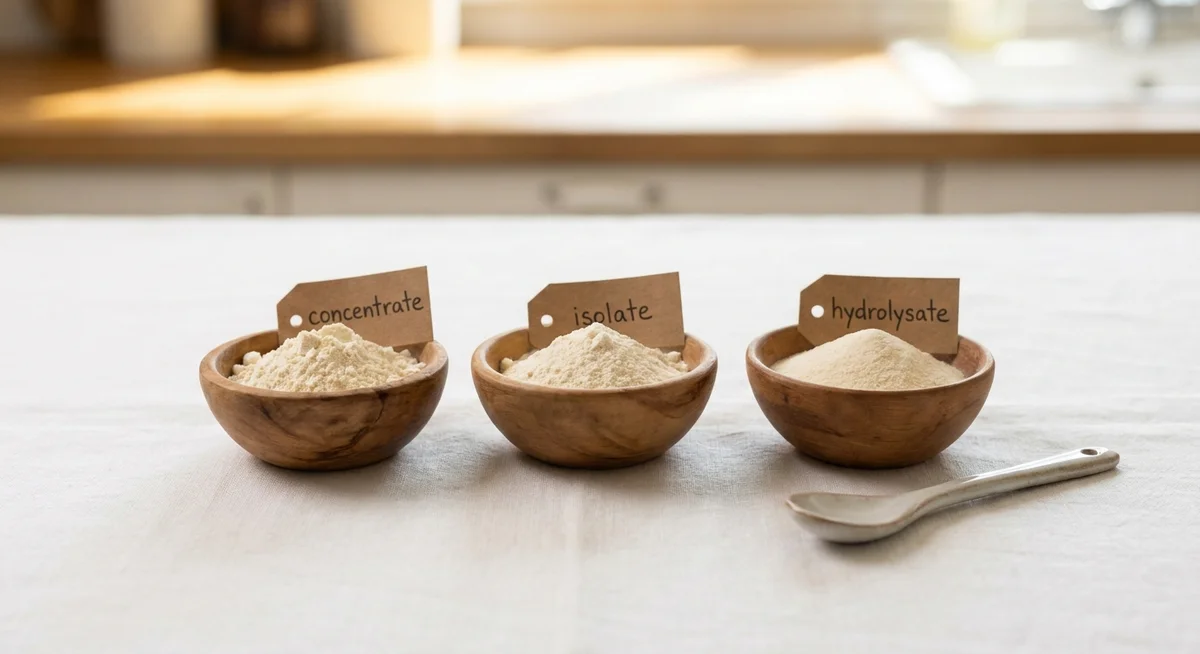
Concentrate vs Isolate vs Hydrolysate: The Quick Decoder
The whey aisle can feel like alphabet soup, so here is the simple breakdown.
- Whey Protein Concentrate (WPC): Usually 70 to 80% protein. Cheaper to produce, still contains a fair bit of lactose and fat. Works fine for people who tolerate dairy well and are not chasing a lean macro profile.
- Whey Protein Isolate (WPI 90): Around 90% protein. Most of the lactose and fat are gone. Easier on the stomach for people with mild lactose sensitivity, and the per-scoop protein count is genuinely high without padding from carbs or fats.
- Whey Protein Hydrolysate (WPH): Whey that has been pre-digested using enzymes, breaking the protein into smaller peptides. Absorbs the fastest but often tastes bitter and costs more.
For most people chasing a clean, fast-absorbing protein that mixes well and does not cause stomach drama, WPI 90 hits the sweet spot. It is the version of whey that delivers the most protein for the least amount of everything else.
The Lactose Question (And Why So Many People Feel It)
A surprisingly large slice of the population has some level of lactose intolerance. For many, the symptoms are mild enough to ignore most of the time, but a daily protein shake made from a lactose-heavy concentrate can turn into a daily bloating session without the connection ever clicking.
Because WPI 90 has had most of its lactose filtered out during processing, it tends to be much friendlier on the gut. People who have written off whey entirely because of digestive issues are sometimes surprised to find that a true isolate sits with them just fine. It is not a guarantee for everyone, but it is a meaningful difference.
The other side of the same coin is fat content. Concentrates can carry several grams of fat per serve, which is not inherently bad, but for someone tracking macros tightly or wanting a leaner shake, an isolate keeps the per-serve fat down near zero. The result is a protein hit that is genuinely lean, not just labelled that way.
The Benefits Beyond the Macro Sheet
Protein powder gets pigeonholed as a gym thing, but the benefits of a high-quality whey isolate stretch well beyond muscle building.
Muscle Recovery and Growth
Whey is exceptionally rich in branched-chain amino acids, especially leucine. Leucine is the trigger for muscle protein synthesis, which is the body's process for repairing and building muscle tissue after exercise. WPI 90 delivers a concentrated dose of these aminos without the extra carbs and fats slowing absorption.
Satiety and Weight Management
Protein is the most filling of the three macronutrients. Hitting a solid protein intake across the day helps keep hunger in check, which makes a difference for anyone trying to manage their weight without feeling deprived. A clean isolate makes that easier because the calories come almost entirely from protein.
Everyday Wellness
Adequate protein intake supports skin, hair, nails, immune function, bone health, and the maintenance of lean tissue as people age. After about 30, the body slowly loses muscle mass each decade unless that loss is actively pushed back against with training and protein. A daily shake is one of the simplest tools for keeping that intake up.
Convenience That Does Not Compromise
Cooking, weighing, and timing whole-food protein every few hours is great in theory and tough in practice. A scoop of quality whey in water or milk is 30 seconds of work for 25 to 30 grams of complete protein. That kind of convenience is the difference between hitting daily targets consistently and falling short.
Why Quality Actually Matters
It would be easy to assume that all WPI 90 products are basically the same. The number is the number, after all. But the reality is that quality varies enormously across brands, and the differences come from several places.
Source of the milk. Whey from grass-fed cows raised on pasture tends to have a cleaner amino profile and a better fatty acid balance than whey from heavily industrialised dairy systems. The diet of the cow shows up in the final product.
Filtration method. Cross-flow microfiltration is gentler and preserves more of the bioactive protein fractions than older ion-exchange methods, which use chemicals and high heat that can denature the protein.
Additives and fillers. Cheaper products often pad themselves with thickeners, artificial sweeteners, soy lecithin in heavy doses, and amino acid spiking, which is the practice of adding cheap free-form amino acids to inflate the protein number on a nitrogen test. A premium isolate keeps the ingredient list short and honest.
Mixability and taste. A good WPI 90 should dissolve cleanly without chalkiness or foam, and taste like something a person would actually want to drink twice a day. These qualities come from careful processing, not from dumping in more sugar and flavouring.
The takeaway is that the number on the front of the tub is only the start of the story. What matters is how the powder is made, where the milk came from, and what does and does not get added along the way.
The Bottom Line
Whey protein has earned its spot at the top of the supplement world because it works. It is complete, fast-absorbing, affordable compared to most protein sources, and backed by decades of research. WPI 90 takes that already strong foundation and refines it into something cleaner, leaner, and easier on the gut. For people who care about what actually goes into their body, the jump from a generic concentrate to a properly made isolate is one of the easiest wins in nutrition.
The protein game is not about finding the loudest tub or the cheapest scoop. It is about finding a product that delivers what it promises, sits well in the body, and supports the goals being chased. A high-quality WP