The Curd, The Whey, and Everything Between: A Plain-English Guide to WPI 90

Walk down any supplement aisle and the word "whey" is everywhere. It's on tubs the size of small children, on protein bars, on ready-to-drink shakes, even on cereal these days. But for something so common, surprisingly few people actually know what whey is, where it comes from, or why one tub costs twenty bucks while another costs a hundred.
The short version: whey is the liquid that separates from milk during cheese-making. The long version is a lot more interesting, and it's the difference between a protein that genuinely supports a healthy lifestyle and one that just fills a scoop.
This is a casual tour through how whey protein gets made, what the different types actually mean, and why something like a properly filtered WPI 90 sits at the top of the food chain.
So What Is Whey, Really?
Milk is roughly 87% water, and the rest is a mix of fats, sugars (lactose), and two main protein groups: casein and whey. Casein makes up about 80% of milk protein and is the slow-digesting one. Whey is the other 20%, and it's the fast-acting, amino-acid-rich fraction that the fitness world fell in love with.
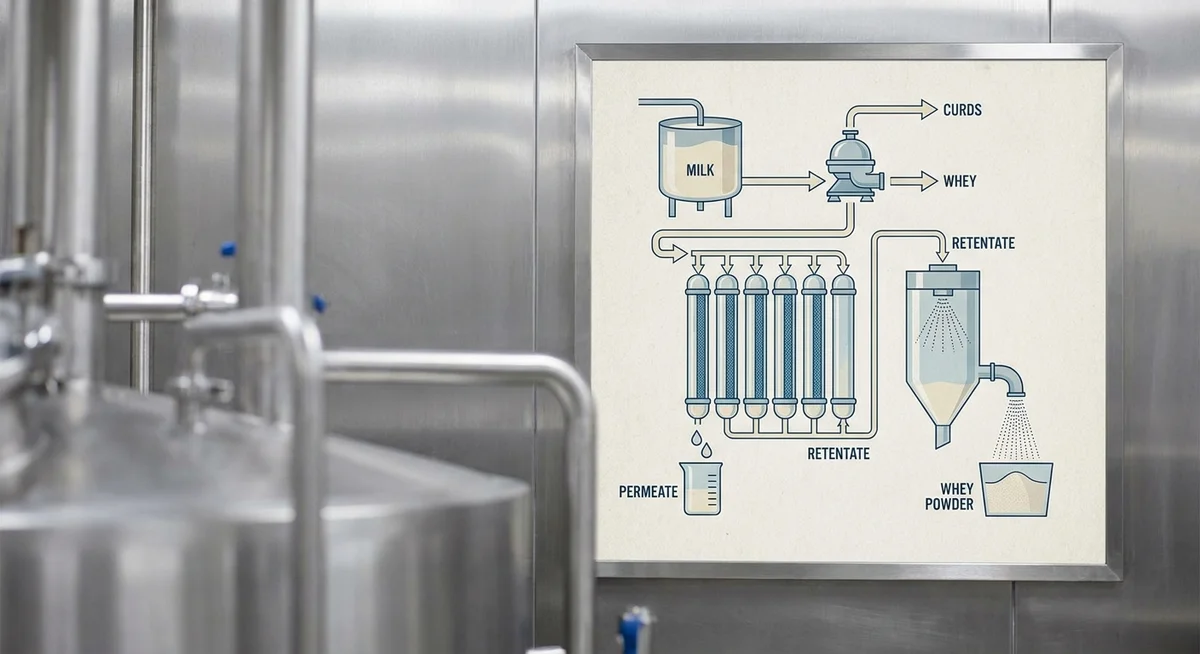
When cheesemakers add enzymes or acids to milk, the casein clumps together into curds. The watery, greenish-yellow liquid left behind is whey. For most of human history, that liquid was considered a byproduct. Farmers fed it to pigs. Some cultures drank it. Hippocrates apparently prescribed it. But it wasn't until food science caught up that anyone realised this leftover liquid was packed with some of the most bioavailable protein on the planet.
That's the starting point. Everything else comes down to how it's processed from there.
From Liquid Whey to Powder: The Processing Ladder
The journey from cheese vat to protein tub is where things get interesting, because this is where the different "types" of whey are born. They all start from the same place. They just travel different distances.
Whey Protein Concentrate (WPC)
This is the most common and the cheapest. Liquid whey gets filtered to remove some of the water, lactose, and minerals, then dried into powder. Depending on how aggressive the filtration is, WPC can range anywhere from 35% to 80% protein by weight. The rest is fat, carbs (mostly lactose), and moisture.
WPC tastes creamy because of those fats and sugars, but it can be rough on people who are lactose intolerant, and a fair chunk of every scoop isn't actually protein.
Whey Protein Isolate (WPI)
Take WPC and put it through additional filtration, usually cross-flow microfiltration or ion exchange, and most of the remaining fat and lactose gets stripped out. The result is a powder that's typically 90%+ protein by weight. That's where the "90" in WPI 90 comes from. Ninety grams of protein per hundred grams of powder.
Whey Protein Hydrolysate (WPH)
This one's been put through enzymatic processing to "pre-digest" the protein into smaller peptide chains. It absorbs slightly faster but tastes notoriously bitter and costs a premium. It's mostly used in clinical nutrition and infant formulas.
Why WPI 90 Sits in a Different League
If WPC is a decent everyday option and WPH is the specialised cousin, WPI 90 is the sweet spot for people who actually care what's in their scoop. Here's what that 90% number really translates to in practice.
More protein, less filler. A 30g scoop of WPI 90 delivers around 27g of pure protein. The same scoop of a 70% concentrate delivers about 21g, and that extra 6g of "stuff" is mostly lactose and fat. Over a month of daily use, that adds up fast.
Easier on the gut. Because most of the lactose has been filtered out, WPI is far more tolerable for people who get bloated, gassy, or generally miserable after dairy. It's not quite lactose-free, but it's close enough that most lactose-sensitive folks handle it without issue.
Lower in fat and carbs. For anyone counting macros or eating in a deficit, WPI gives more protein per calorie than just about any other whole-food or supplement source.
Fast absorption. Whey is already one of the quickest-digesting proteins around, and isolating it pushes that even further. It hits the bloodstream within roughly 30 to 60 minutes, which is exactly what muscles want after a hard session.
The difference between a 70% concentrate and a 90% isolate isn't just numbers on a label. It's the difference between drinking protein and drinking protein plus a bunch of things you didn't ask for.
The Benefits, Beyond Just Building Muscle
The protein-and-gym crowd gets most of the attention, but whey protein has a much broader range of benefits that often get glossed over. Worth running through them properly.
Muscle Repair and Growth
This is the obvious one. Whey is rich in leucine, the amino acid that flips the switch on muscle protein synthesis. Studies have consistently shown that whey outperforms most other protein sources for post-exercise recovery, gram for gram.
Appetite Regulation
Protein is the most satiating macronutrient, and whey in particular has been shown to influence hunger hormones like ghrelin and GLP-1. A whey shake in the morning often kills cravings for hours.
Immune Support
Whey contains immunoglobulins, lactoferrin, and other bioactive compounds that play a role in immune function. The higher the quality of the whey and the gentler the processing, the more of these delicate proteins survive intact.
Healthy Ageing
Maintaining muscle mass becomes a real concern past about age 40, and protein requirements actually go up with age, not down. A clean isolate is one of the easiest ways for older adults to hit their protein targets without overloading on calories.
Convenience That Doesn't Compromise
Eating 30g of protein in whole foods means a chicken breast, a tin of tuna, or a hefty serving of Greek yoghurt. None of those are quick at 6am. A shake takes 30 seconds.

Why Quality Actually Matters (And How to Spot It)
Here's where the industry gets murky. Not all WPI is created equal, and the label doesn't always tell the full story. A few things separate genuinely premium whey from the stuff that just says premium on the front.
Source of the Milk
Cows that are grass-fed, pasture-raised, and free from added hormones produce milk with a better fatty acid profile and higher levels of beneficial compounds. The whey from that milk carries those benefits forward. Bulk industrial whey from anonymous sources usually doesn't have the same story behind it.
Filtration Method
Cross-flow microfiltration uses ceramic membranes and physical separation, which preserves the native protein structures and bioactive fractions. Ion-exchange filtration is cheaper but uses chemicals that can denature some of those delicate compounds. The end protein number might look the same, but what's inside is different.
Minimal Additives
A clean label is a quick tell. If the ingredient list runs ten lines deep with thickeners, artificial sweeteners, gums, and fillers, that's a sign the manufacturer is masking lower-quality base powder. Premium WPI should read short and clean.
Third-Party Testing
The supplement industry is notoriously self-regulated. Brands that submit their products for independent testing are putting their money where their mouth is. Look for batch testing, lab certificates, or transparent sourcing information.
Taste and Mixability
This is the practical test. High-quality WPI mixes cleanly in a shaker with just water, dissolves without clumping, and tastes smooth without that chalky, gritty aftertaste cheaper powders are famous for. If a protein needs a blender and three flavours of artificial sweetener to be drinkable, something's off.
Common Misconceptions Worth Clearing Up
A few things people seem to believe about whey protein that don't quite hold up:
- "Protein is bad for your kidneys." This myth refuses to die, but it only applies to people with pre-existing kidney disease. Healthy kidneys handle high-protein diets without issue, and decades of research back that up.
- "You can't absorb more than 30g at once." The body absorbs all of it. It just uses some for muscle synthesis and the rest for other purposes. Eating more protein at one sitting isn't wasted.
- "Whey is only for bodybuilders." Whey is for anyone trying to hit a daily protein target, which is most people, since most people are under-eating protein.
- "Isolate is too processed to be natural." Filtration is a physical process. It's not adding anything. It's just removing what isn't protein.
The Bottom Line
Whey protein went from being a discarded liquid byproduct to one of the most studied, most useful nutritional tools available. But the gap between the cheapest concentrate and a properly made isolate is wider than most people realise, and that gap shows up in the macros, the digestion, the taste, and the actual results.
A premium WPI 90 isn't about chasing