The Cold Hard Truth About Whey Protein: Why Not All Tubs Are Created Equal
Walk down the supplement aisle of any health store and the wall of protein tubs starts to look like a candy shop on steroids. Bright labels, bold claims, mysterious blends, and prices that swing from suspiciously cheap to eyebrow-raisingly expensive. Somewhere in that noise sits a quiet truth: the protein inside those tubs is not all the same, and the difference between a budget concentrate and a premium isolate is bigger than most people realise.
This is a look at what whey protein actually is, how it gets from a dairy farm into a scoop, and what that little "90" stamped on a tub of WPI really means. No marketing fluff, just the stuff worth knowing before the next shake gets mixed.
What Whey Protein Really Is (Spoiler: It's Cheese Leftovers)
Here's a fun fact that gets glossed over in fitness ads: whey started its life as a byproduct of cheesemaking. When milk is curdled to make cheese, it separates into two parts. The thick stuff that becomes cheese is the curd. The thin, watery liquid left behind is whey. For centuries, this liquid was either discarded, fed to pigs, or used in small amounts in baking.
Then food scientists figured out something interesting. That watery leftover was packed with high-quality protein, including all nine essential amino acids and a particularly generous helping of branched-chain amino acids (BCAAs). What was once considered waste turned into one of the most studied and consumed sports nutrition ingredients on the planet.
The catch is that raw liquid whey is mostly water, with a bit of lactose, some fat, and a relatively small portion of actual protein. To turn it into the powder that ends up in a shaker, that liquid has to be filtered, concentrated, and dried. The way it gets filtered is where everything starts to matter.
Concentrate, Isolate, Hydrolysate: The Family Tree Explained
There are three main forms of whey protein on the market, and they're often lumped together as if they're interchangeable. They're not.
Whey Protein Concentrate (WPC)
This is the entry-level option. Concentrates typically sit anywhere between 30% and 80% protein by weight, with the rest being lactose, fat, and moisture. They're cheaper to produce because they require less filtration. The taste is creamier and the texture is thicker, but the trade-off is more sugar (lactose), more fat, and a higher chance of stomach upset for anyone with even mild lactose sensitivity.
Whey Protein Isolate (WPI)
Isolates take the process further. Through additional filtration, most of the lactose, fat, and other non-protein components are stripped out, leaving a powder that's typically 90% or more protein by weight. That's where the "90" in WPI 90 comes from. It's not a marketing number pulled out of thin air. It's a measurable benchmark of purity.
Whey Protein Hydrolysate (WPH)
Hydrolysates are isolates (or sometimes concentrates) that have been partially broken down using enzymes. The idea is faster absorption, though the research on whether this actually makes a meaningful difference for most people is mixed. They tend to be expensive and taste bitter, which is why they're more common in clinical and infant nutrition than in everyday tubs.
How WPI 90 Actually Gets Made
The journey from milk to a tub of premium isolate is more technical than most people expect. Here's a simplified version of what happens behind the scenes.
- Milk collection. Fresh cow's milk arrives at the processing facility, where it's tested for quality, hormones, and contaminants.
- Cheese production. Enzymes or acids are added to separate curds from whey. The liquid whey is collected.
- Pasteurisation. The whey is heat-treated to kill off any unwanted bacteria.
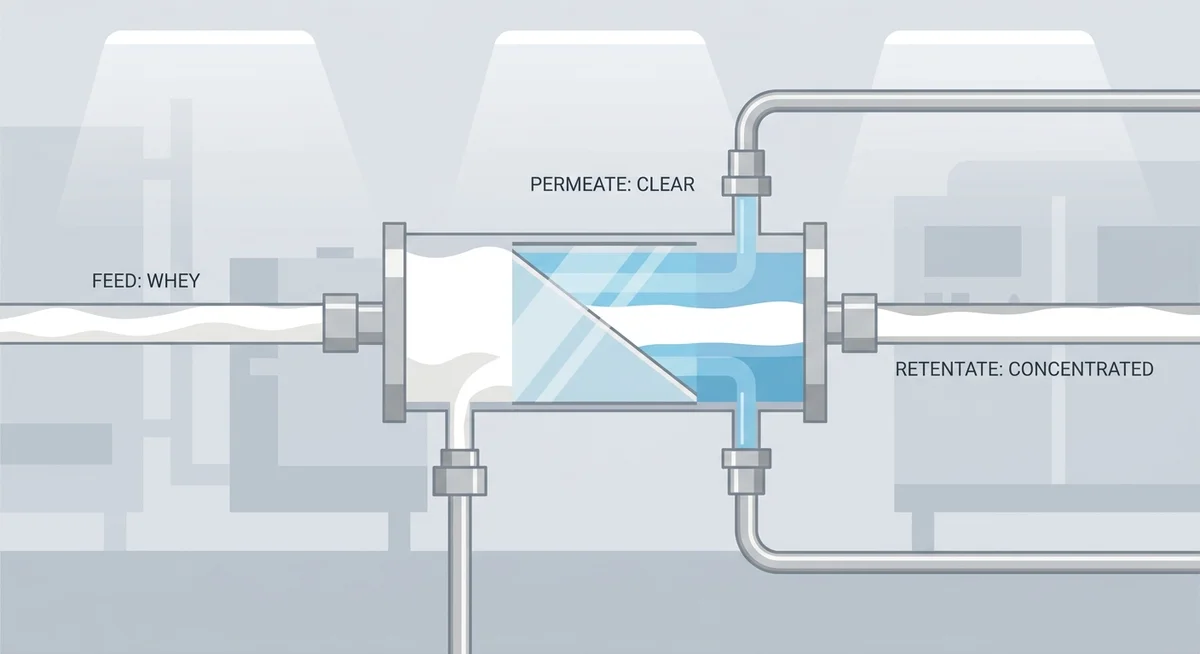
- Microfiltration or ion exchange. This is the step that defines isolate. Microfiltration uses ceramic membranes with tiny pores to physically separate protein from lactose, fat, and ash. Ion exchange uses charged resins to pull protein out based on electrical properties. Both methods can produce a 90% protein result, though microfiltration tends to preserve more of the natural protein fractions like lactoferrin and immunoglobulins.
- Concentration and drying. The protein-rich liquid is then evaporated and spray-dried into the fine powder that gets packaged.
- Flavouring and blending. Finally, natural or artificial flavours, sweeteners, and sometimes thickeners are blended in.
The cleaner the source milk and the more careful the filtration, the better the final product. Cheap whey can be produced from lower-grade milk and pushed through less refined processes, which is why two tubs labelled "isolate" can actually be quite different in real-world quality.
The Benefits Worth Caring About
Whey protein has been studied more than almost any other supplement on the market, and the benefits aren't just gym-bro mythology. They're backed by decades of research.
- Muscle protein synthesis. Whey is particularly rich in leucine, the amino acid that acts as the main trigger for muscle building. Studies consistently show whey outperforms most other protein sources at stimulating muscle repair after exercise.
- Satiety and weight management. Protein keeps people fuller for longer, and whey has been shown to reduce hunger hormones and curb appetite, which helps with body composition goals.
- Convenient protein quantity. Hitting a daily protein target of 1.6 to 2.2 grams per kilogram of bodyweight (the range often suggested for active adults) is genuinely hard from food alone. A scoop of WPI 90 delivers around 25 grams of protein in a serving with minimal calories.
- Immune support. Whey contains bioactive compounds like immunoglobulins and lactoferrin that have been linked to immune function, though the amounts depend heavily on processing.
- Easy on the stomach (when it's isolate). Because WPI 90 has had most of the lactose stripped out, it's often tolerated by people who can't handle regular dairy or cheaper concentrates.
Why Quality Actually Matters More Than the Price Tag
There's a temptation to grab the cheapest tub on the shelf and call it a day. After all, protein is protein, right? Not quite. Here's where quality starts to separate itself from quantity.
Protein Spiking and Amino Acid Padding
Some lower-tier brands have been caught adding cheap free-form amino acids like glycine or taurine to inflate the total protein number on the label. The total nitrogen content reads correctly, but the protein isn't actually whole, functional protein. With a properly produced WPI 90, the protein listed is the protein delivered.
Source Milk and Cow Welfare
Premium whey usually comes from grass-fed, hormone-free dairy from regions known for high dairy standards, like Australia, New Zealand, and parts of Europe. The quality of the milk influences the amino acid profile, the presence of beneficial fats, and the overall purity of the final powder.
Filtration Method
Cold microfiltration preserves the delicate protein structures and bioactive compounds. High-heat or chemical processing can denature proteins and reduce their effectiveness. A premium WPI 90 is processed gently to keep those native proteins intact.
What's Not on the Ingredient List
Quality whey doesn't need fillers, gums, artificial colours, or mystery "proprietary blends." A short, clean ingredient list is one of the easiest ways to spot a serious product.
The 10% difference between an 80% concentrate and a 90% isolate isn't just a number on a label. It's the difference between consuming protein and consuming sugar, fat, and additives alongside that protein.
Who Actually Benefits Most From WPI 90
WPI 90 isn't just for bodybuilders, even though that's the stereotype. The people who get the most out of a high-purity isolate tend to fall into a few categories.
- Anyone watching macros closely. If carbs and fats are being tracked, a near-zero carb, near-zero fat protein source is gold.
- People with lactose sensitivity. Most of the lactose has been filtered out, making it far easier to digest than concentrates.
- Athletes recovering between sessions. Fast absorption and a high leucine content make it ideal post-workout.
- Older adults. Protein needs actually go up with age, and a clean isolate is an efficient way to maintain muscle mass without overloading on calories.
- Anyone who simply struggles to hit protein targets through food. Cooking that much chicken every day gets old fast.
The Bottom Line
Whey protein is one of the most useful, well-studied, and practical supplements available. But the version inside the tub matters enormously. A cheap concentrate and a premium isolate share a name, but they don't share a profile, a process, or a result.
WPI 90 sits at the higher end of the spectrum for a reason. It's the result of better source milk, more careful filtration, and a refusal to compromise on what ends up in the powder. The 90% number isn't a marketing flourish. It's a quality benchmark, and once that benchmark becom