Does Processing Destroy Your Whey Protein? What Denaturation Actually Means
Pull up almost any premium whey protein and you'll see words like "cold-processed" or "low-heat" on the label. But what do they actually mean? The short answer: heat changes the shape of protein molecules, and shape determines how well those molecules work inside your body. Understanding denaturation takes about five minutes and will change how you read every protein label you pick up from here on.
Key takeaways
- Denaturation is a structural change in a protein molecule, not the destruction of amino acids.
- Mild denaturation is fine for muscle building. Heavy heat processing can reduce bioactive fraction quality and digestibility.
- WPI 90 made via cold cross-flow microfiltration retains the most intact bioactive proteins.
- "Low-heat" on a label is meaningful only when backed by a cold-processing method like microfiltration, not just a marketing phrase.
- Your results at the gym are the real test, but knowing what to look for helps you choose better from the start.
What does denaturation actually mean?
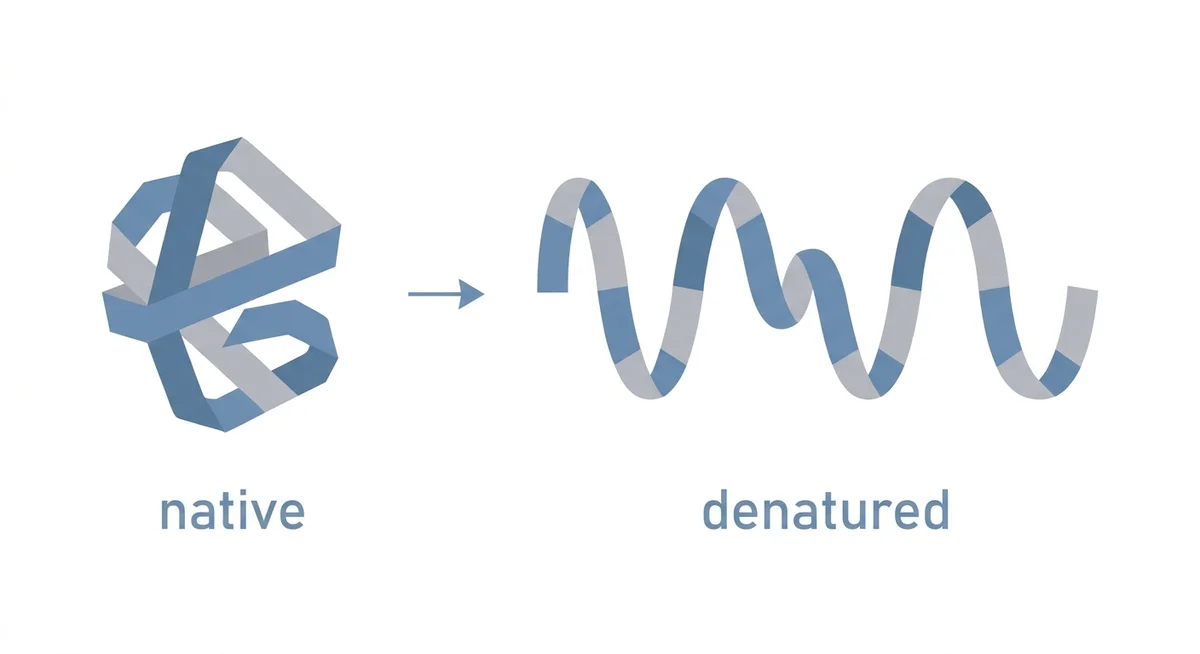
Proteins aren't just chains of amino acids. They're folded into specific three-dimensional shapes held together by chemical bonds. That shape is what lets a protein do its job, whether it's contracting muscle fibers, catalyzing a reaction, or shuttling nutrients through a cell wall. Denaturation is when that shape unfolds or collapses, usually because of heat, but also from acid, mechanical shearing, or even extreme cold.
Here's the critical nuance most people miss: denaturation does NOT destroy amino acids. The building blocks are still there after denaturation. What changes is the protein's three-dimensional structure and, by extension, some of its biological functions. For pure muscle building, a fully denatured whey protein still delivers its amino acids. But for the broader spectrum of benefits, including immune support, antioxidant production, and gut health, intact bioactive proteins matter a lot.
Which proteins in whey are most vulnerable to heat?
Whey isn't one protein, it's a mixture. Each fraction has a different heat sensitivity, which is why processing method matters so much.
| Whey Fraction | % in Raw Whey | Heat Sensitivity | Key Role |
|---|---|---|---|
| Beta-lactoglobulin | ~50% | Moderate | Primary amino acid carrier, BCAA-rich |
| Alpha-lactalbumin | ~20% | High | Tryptophan source, sleep and mood support |
| Immunoglobulins | ~10-15% | Very high | Immune function, gut barrier support |
| Lactoferrin | ~1-2% | Very high | Antimicrobial, iron-binding, immune modulation |
| Bovine serum albumin | ~5% | High | Antioxidant precursor (glutathione pathway) |
Beta-lactoglobulin is relatively heat-tolerant, which is why even standard pasteurization doesn't gut your amino acid delivery. But immunoglobulins and lactoferrin are fragile. Extended high-heat processing or multiple heat cycles can denature these fractions significantly, leaving you with a powder that's fine for muscle repair but stripped of most of its secondary benefits.
How does processing method affect denaturation?
The manufacturing route your WPI 90 takes from liquid whey to finished powder determines how much heat the protein sees. There are two main routes:
Cold cross-flow microfiltration
- Uses physical membrane filters at low temperatures
- No heat required to separate protein from fat and lactose
- Preserves immunoglobulins, lactoferrin, and alpha-lactalbumin at higher levels
- Produces a cleaner, more neutral flavor profile
- Generally more expensive to run, reflected in the price
Ion exchange processing
- Uses chemical agents to bind and release protein fractions
- Can involve heat steps during processing
- Achieves very high protein percentages (90%+) efficiently
- May denature heat-sensitive fractions like immunoglobulins
- Lower production cost, often lower shelf price
Both methods produce a high-protein powder. The difference shows up in what's left beyond the amino acid count. If you're buying WPI 90 specifically because you want the full package, processing method is the variable worth caring about. The article on cross-flow microfiltration vs. ion exchange goes deeper on the technical comparison if you want the full picture.
Does denaturation affect how quickly your body absorbs the protein?
Partially, yes. Native proteins have to be unfolded by digestive enzymes before absorption can happen. In most cases, mild denaturation (the kind caused by normal stomach acid anyway) actually speeds up digestion slightly, because the structure is already partly open. Heavy denaturation from excessive heat processing is a different story: it can cause proteins to aggregate into clumps that are harder to break down, potentially slowing absorption and causing some of the digestive discomfort people blame on lactose.
This is worth keeping in mind if you've switched between brands and noticed a difference in how your stomach handles them. Processing method is often the real culprit, not the lactose content. WPI 90 made with low-heat methods tends to dissolve cleanly and sit well, which is a useful signal even before you look at a spec sheet.
So how much does denaturation actually affect your results?
For pure hypertrophy, the effect is modest. Your muscles don't care whether the leucine that triggered protein synthesis came from a native or denatured protein. Amino acids are amino acids once digestion is done. Where denaturation bites is in the secondary benefits: immune resilience, gut health, antioxidant production, and recovery beyond the muscle itself. These are real, documented effects linked to intact bioactive fractions, and they erode when those fractions are damaged during processing.
For most people training consistently, these secondary benefits are the margin. They're what separates "I recover well" from "I'm always a bit run down." They don't show up in a single session, but they accumulate over weeks and months. That's why quality matters, and why it's worth paying a little more for a powder that's been processed with care. The breakdown on what actually makes WPI 90 the gold standard explains how these factors play out in the broader quality picture.
What to look for on the label
Marketing copy is easy to write and hard to verify. Here are the signals that actually mean something:
- Cold-processed or low-heat filtered: Meaningful if the method is microfiltration, not just a marketing phrase attached to ion-exchange.
- Microfiltration or CFM listed as the processing method: This is the clearest positive signal.
- Protein percentage at or above 90% on a dry basis: Indicates efficient processing without relying on excessive drying heat.
- Lactoferrin or immunoglobulins listed in the ingredient breakdown: Their presence (even in small amounts) suggests the processing was gentle enough to preserve them.
- Short ingredient list: Fewer additives usually means less need to mask a poor base protein.
The guide to reading a whey protein label covers these markers in more detail, including the ones that are pure noise.
FAQ: Denaturation and whey protein quality
Is denatured whey protein useless?
No. Denatured whey still delivers all its amino acids and will absolutely support muscle protein synthesis. What you lose with heavy denaturation are the bioactive fractions: immunoglobulins, lactoferrin, and some of the intact whey fractions that support immune function and gut health. For pure amino acid delivery, denaturation barely matters. For the full benefit profile of WPI 90, it does.
Does cooking with whey protein denature it?
Yes, baking or cooking whey protein does cause denaturation. But for cooking purposes, this is fine. The amino acids survive heat intact. You lose some bioactive function, but cooked protein in a pancake or muffin was never expected to deliver immunoglobulin activity. The guide to cooking with WPI 90 covers exactly this trade-off.
Can you tell if a protein is denatured just by looking at it?
Not reliably. Heavily denatured protein can appear slightly more yellow-tinged than native whey and may clump more when wet, but these are rough indicators, not definitive tests. The most reliable approach is to buy from a brand that discloses its processing method and backs it with third-party testing, rather than trying to judge quality by appearance alone.
Does denaturation change the calorie content of protein?
No. Denaturation is a structural change, not a chemical breakdown of the molecule. The caloric value of protein, roughly 4 calories per gram, stays the same whether the protein is in its native folded state or fully denatured. The amino acid profile also remains intact. Only the three-dimensional architecture and related bioactivity change.
See what a cold-processed WPI 90 actually looks likePremium WPI 90, made with low-heat microfiltration and nothing you don't need.