WPI 90 vs. Casein: Which Protein Is Better Before Bed?

If you train in the evening, the bedtime protein question comes up fast. Casein has been the standard answer for years. But WPI 90 absorbs differently, costs less per gram of protein, and works well in contexts most people haven't thought through. The honest answer is that neither one is universally better — the right pick depends on what you actually did that day and what your body needs overnight.
Key takeaways
- Casein digests slowly over 5 to 7 hours; WPI 90 delivers a fast, sharp spike of amino acids within 60 to 90 minutes.
- After an evening training session, WPI 90's fast absorption may actually be the better immediate choice.
- Casein holds an edge if you're going to bed without having trained that day, or if you want a sustained trickle of amino acids while you sleep.
- Cost per gram of protein is noticeably lower with WPI 90, which matters if you're taking protein twice a day.
- Mixing WPI 90 with casein (or a slow-digesting food) gives you the best of both worlds without buying two separate tubs.
What actually happens when you digest each protein?
Casein forms a gel when it hits stomach acid. That gel slows digestion, releasing amino acids over roughly five to seven hours. WPI 90 stays liquid, passes through the stomach quickly, and pushes a concentrated wave of amino acids into your bloodstream within 60 to 90 minutes. Both proteins contain all the essential amino acids. Both have high leucine content. The real difference is the delivery speed.
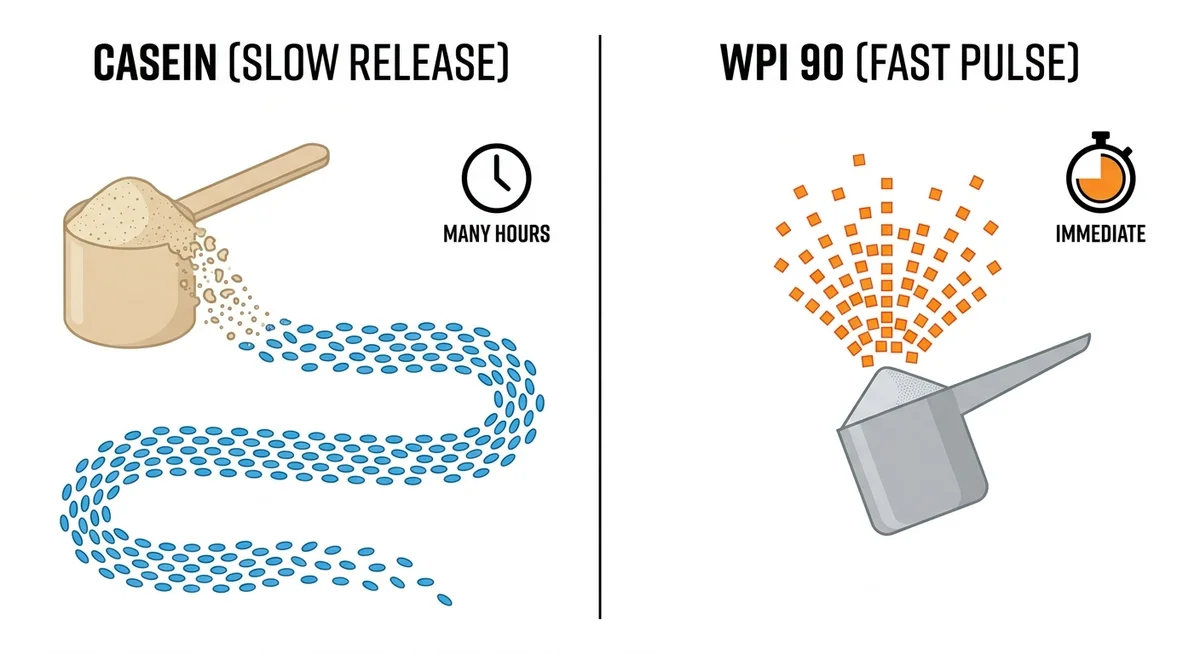
That speed difference is why the "casein before bed" rule became popular. The theory: keep amino acid levels elevated during the 7 to 8 hours you're not eating so your muscles have a constant supply to repair with. It's a reasonable theory. But it has a gap in it that most people skip over.
Does the "slow protein at night" rule actually hold up?
The original research supporting casein for overnight recovery mostly looked at people who were sedentary or who trained in the morning, not people who had just finished a hard session two hours before sleeping. When you train in the evening, your muscles are acutely damaged and primed to absorb protein right now. In that window, a fast protein like WPI 90 may actually do more useful work than casein would.
A few things worth knowing about WPI 90's effect on muscle soreness and recovery: the fast leucine spike it triggers is a key driver of muscle protein synthesis. That spike is blunted by slow digestion. Casein raises your amino acid levels, but gently. After hard training, gentle might not be what your muscles need first.
| Factor | WPI 90 | Casein |
|---|---|---|
| Digestion speed | Fast (60 to 90 min peak) | Slow (5 to 7 hours) |
| Leucine spike | High and sharp | Low and gradual |
| Best use case | Post-exercise recovery, including evening sessions | Long overnight fast, no recent training |
| Protein per 100g | ~90g (WPI 90 standard) | ~80g (typical micellar casein) |
| Mixability | Excellent in water or milk | Thick, best in milk or blended |
| Cost per gram of protein | Lower | Higher |
| Satiety | Moderate | High (gel fills the stomach) |
When does casein genuinely win?
Casein earns its place in two clear situations. First, rest days — if you haven't trained, there's no acute repair signal. A slow, sustained amino acid feed while you sleep helps protect muscle from overnight breakdown without needing to time anything precisely. Second, if you're cutting calories aggressively, casein's satiety effect is real. The gel in your stomach keeps hunger quiet for longer, which matters a lot when you're eating below maintenance.
What about combining them?
Some people do both: WPI 90 immediately after training, casein an hour before bed. That covers the acute recovery window and the overnight fast. It's not complicated, and it works. The downside is cost — you're buying two protein sources. If budget is the constraint, leaning on WPI 90 post-training and using high-casein whole foods (Greek yogurt, cottage cheese, milk) before bed gets you close to the same outcome for less.
Understanding how to spread protein across the day matters here too. The overnight fast is real but it's only one of four or five protein meals most active people should be eating. Getting those other meals right has a bigger impact than agonising over exactly which powder you use at 10pm.
Reasons to choose WPI 90 before bed
- You trained within 3 hours of sleeping
- You want the highest protein content per gram of powder
- You mix it with casein-rich food (yogurt, cottage cheese)
- You're on a budget and need one powder to do everything
- You want it to actually dissolve in a shaker, not thicken into paste
Reasons to choose casein before bed
- Rest day with no training
- Aggressive calorie deficit where hunger control matters
- You don't mind the thicker texture
- You want the simplest possible overnight amino acid coverage
- You're already hitting post-workout protein with a different source
Frequently asked questions
Is it bad to take WPI 90 right before bed?
No. WPI 90 before bed is fine, especially if you trained that evening. The fast absorption means your muscles get a strong amino acid signal quickly, which is useful in the hours after exercise. The main trade-off is that it won't keep amino acid levels elevated through the whole night the way casein does. If that matters to you, pair it with a casein-rich food rather than switching powders entirely.
Will casein make me gain fat while I sleep?
No more than any other protein source. Protein has the highest thermic effect of the three macronutrients, meaning your body burns more energy digesting it than it does with carbs or fat. A 30 to 40g serve of casein before bed contributes around 120 to 160 calories, which fits into a normal daily target without issue. The research on bedtime protein consumption shows no meaningful fat gain compared to taking the same calories earlier in the day.
Does WPI 90 have any casein in it?
No. WPI 90 is made from whey, which is the liquid that separates from the curd during cheese-making. Casein is what becomes the curd. The two proteins come from the same milk but go in completely different directions after that. The curd and whey separation process is actually what gives WPI 90 its fast-absorbing character.
How much protein do I actually need before bed?
Most research points to 30 to 40 grams as the practical ceiling for a single sitting. Above that, the extra protein still gets used, but there are diminishing returns. A standard serve of WPI 90 (30 to 35g of powder) typically lands at 27 to 32g of protein, which sits right in the useful range. If you're larger or training very hard, the top end of that range is worth hitting.
Try a WPI 90 that actually earns its price per servePremium whey protein isolate with 90%+ protein content per scoop.