WPI 90 and Real Food: How to Hit Your Protein Target Every Day

Most people who buy a tub of WPI 90 use it for one thing: the post-workout shake. That's fine, but it leaves a lot on the table. When you treat WPI 90 as one piece of a daily protein strategy rather than a single-slot habit, hitting 140 to 200g of protein per day stops feeling like a grind and starts happening almost automatically.
Key takeaways
- Whole food sources and WPI 90 are complementary, not competing. Use both.
- Spacing protein across 4 to 5 meals maximises muscle protein synthesis throughout the day.
- WPI 90 fills the gaps where whole food is inconvenient, not the other way around.
- A single 30g scoop of WPI 90 delivers roughly 27g of protein with minimal fat and almost zero lactose.
- Planning your food-first meals first makes it easy to see exactly how much WPI 90 you actually need.
Why does spreading protein through the day matter?
Your muscles can only use so much protein at once. Research consistently points to somewhere between 0.4 and 0.55g per kilogram of body weight per meal as the practical ceiling for muscle protein synthesis in a single sitting. For an 80kg person that's roughly 32 to 44g per meal. Eating 160g of protein at dinner doesn't make up for eating close to nothing at breakfast and lunch. The timing spread matters as much as the daily total.
This is where a lot of people quietly fall short. They eat a normal breakfast, have a light lunch, train after work, smash a shake, and then pile most of their protein into the evening meal. The result is one or two well-supplied windows and several hours of the day where muscle protein synthesis is barely ticking over.
The fix isn't complicated. It's just about designing your day so protein shows up consistently, and using WPI 90 to fill the windows where whole food isn't practical.
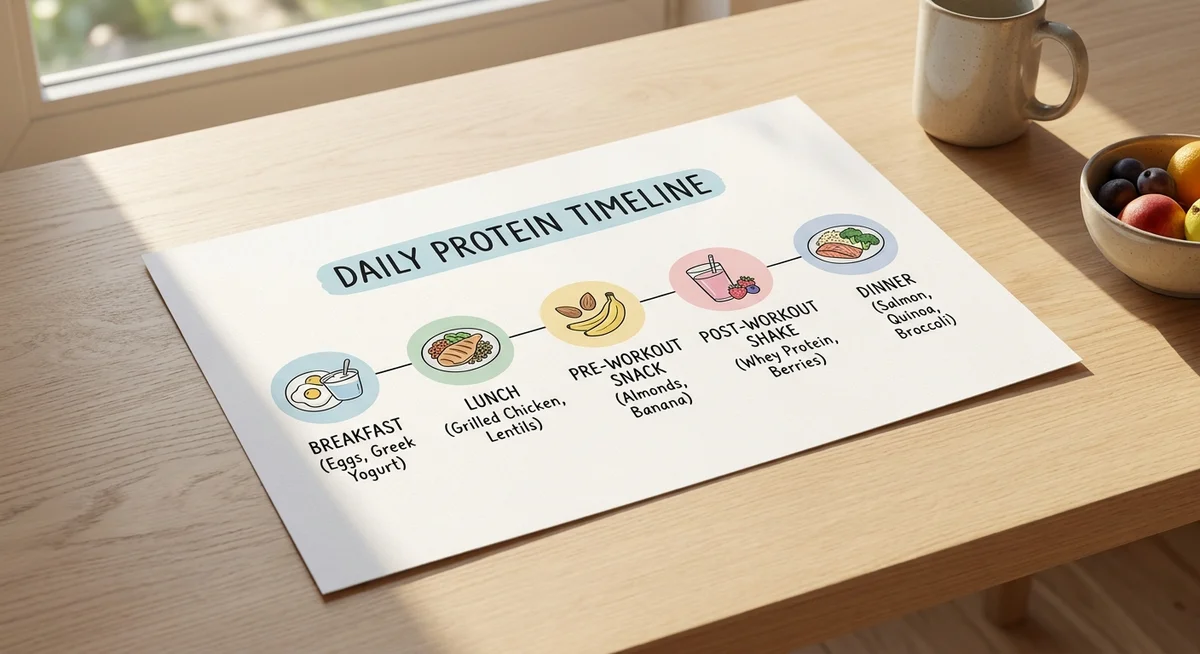
What does a practical daily protein strategy actually look like?
Start with your whole food anchors and build outward from there. Most people already eat two or three solid meals a day. The job is to make sure each one has a meaningful protein contribution, then use WPI 90 to fill any remaining gaps efficiently.
| Eating Window | Whole Food Source | Approx. Protein | WPI 90 Top-Up? |
|---|---|---|---|
| Breakfast (7am) | 3 eggs + 150g Greek yogurt | ~30g | Optional (add a half scoop if under 30g) |
| Mid-morning (10am) | Cottage cheese or tuna snack | ~20g | Not needed |
| Lunch (1pm) | 150g chicken breast + legumes | ~40g | Not needed |
| Post-workout (5pm) | WPI 90 shake (30g scoop) | ~27g | Yes, this IS the protein source |
| Dinner (7pm) | 180g salmon + vegetables | ~36g | Not needed |
| Daily total | ~153g |
That example sits around 153g with just one scoop of WPI 90. For someone training hard and wanting closer to 180g, a second scoop mixed into morning oats or an afternoon smoothie closes the gap without adding much extra prep or calories. The key insight: WPI 90 isn't doing all the heavy lifting. It's covering the windows where whole food is either inconvenient or insufficient.
Which whole foods pair best with WPI 90?
WPI 90 is fast-absorbing. It gets into your bloodstream within 30 to 60 minutes, which makes it genuinely useful around training. Whole food proteins digest more slowly, releasing amino acids over several hours. Pairing them across the day gives you both rapid availability after a session and a slower sustained feed at other times.
Whole food proteins worth anchoring meals around
- Eggs (6g per egg, full amino acid profile)
- Chicken breast (31g per 100g cooked)
- Canned tuna in water (25g per 100g, cheap and portable)
- Greek yogurt, full-fat or low-fat (10 to 17g per 170g serve)
- Salmon or white fish (20 to 25g per 100g cooked)
- Cottage cheese (11g per 100g, slow-digesting casein)
- Lean beef mince (26g per 100g cooked)
Where WPI 90 genuinely fills the gap
- Post-workout when you need fast absorption and can't cook
- Breakfast when eggs alone don't hit your target
- Overnight oats or yogurt bowls that need a protein boost
- Travel days when whole food options are poor
- High-training weeks where appetite drops and food volume feels hard
- Baking and cooking where you want protein without changing the texture much (see our guide on cooking with WPI 90)
How does WPI 90 compare to other protein supplements in a mixed diet?
You could use a standard whey concentrate, a plant blend, or a casein powder to fill the same gaps. Here's why WPI 90 tends to work better as the supplement anchor in a food-based strategy.
Standard whey concentrate sits at around 70 to 80% protein by weight. That means more fat and lactose per scoop for the same protein hit. If your whole food diet already includes dairy and fatty animal proteins across the day, the extra fat from a concentrate adds up. WPI 90 strips that back to around 90% protein per gram, so your supplement contribution stays lean. For people managing lactose sensitivity, WPI 90 is also far easier to digest than concentrate, which matters when you're already eating several meals a day with dairy in them.
Plant proteins do the job, but the amino acid density is lower. You typically need a bigger serve to match the leucine content of a 30g WPI 90 scoop. In a diet that already uses your appetite budget across several solid meals, that's not always practical.
A note on total daily calories, not just protein
Hitting a protein target is only part of the picture. WPI 90 is useful precisely because a 30g scoop adds roughly 27g of protein for about 110 to 120 calories, with almost no fat or carbohydrates. That gives you flexibility to load the rest of your day with whole foods without overshooting your calorie target. For people in a deficit, that caloric efficiency matters. For people in a building phase, whole food sources fill the extra calorie requirement naturally without needing to drink four shakes a day.
If you're not sure how much total protein you need to be aiming for, our goal-by-goal protein breakdown covers the numbers in detail based on body weight and training type.
Frequently asked questions
Can I get enough protein from whole food alone without a supplement?
Yes, in theory. A diet built around meat, fish, eggs, and dairy can absolutely hit 150 to 180g of daily protein without any powder. The practical issue for most people is convenience. Cooking and eating that much whole food across five windows every day takes time and appetite. WPI 90 doesn't replace those meals. It removes the friction from the one or two windows where preparing food isn't realistic.
Is there a risk of eating too much protein when combining food and WPI 90?
For healthy adults, protein intake above the recommended daily minimum is well-tolerated, and the popular claim that high protein intake harms kidneys applies to people with pre-existing kidney disease, not healthy individuals. That said, chasing extremely high intakes (above 2.5g per kilogram of body weight) doesn't add meaningful benefit for most people. Use your daily target as a ceiling, not something to aggressively exceed.
When is the best time to take WPI 90 in a food-based day?
After training is the most well-supported window. Your muscles are primed to take up amino acids, and WPI 90's fast absorption rate makes it a practical match for that moment. Beyond that, use it wherever the gap in your food day is largest. If breakfast protein is consistently low, morning is a better slot than post-workout for your specific pattern. There's no single correct answer; it depends on when your whole food diet leaves room. Our piece on protein timing and absorption goes deeper on this.
How do I know if I need one scoop or two per day?
Add up the protein in your three main whole food meals. If the total sits 30g or more below your daily target, two scoops a day makes sense. If you're within 20 to 30g of your target through food, one scoop after training closes it comfortably. Track for one week, not one day, because food intake varies and a single day can mislead you about your actual average.
See our WPI 90 and accessories Professional-grade whey protein isolate with 90% protein per gram. Made to fit a real daily routine.