Why WPI 90 Rebuilds Muscle Faster Than Most Proteins Can

After a hard training session, your muscles are not just tired, they are literally damaged. Tiny tears in the muscle fibres signal the body to repair and grow back a little stronger. That repair process needs raw material: amino acids. What you eat in the hours after training determines how fast and how completely that repair happens. WPI 90 is well-suited to that job, and this article explains exactly why, without the supplement-industry hype.
Key takeaways
- Muscle repair requires amino acids quickly. Speed of digestion matters.
- WPI 90 digests faster than concentrate or food-based proteins.
- Leucine is the amino acid that "flips the switch" on muscle protein synthesis. WPI 90 is one of the richest dietary sources of it.
- The low fat and carb content of WPI 90 means amino acids reach the bloodstream without delay.
- You don't need a complicated stack. One quality scoop timed well does the work.
What actually happens to muscle after you train?
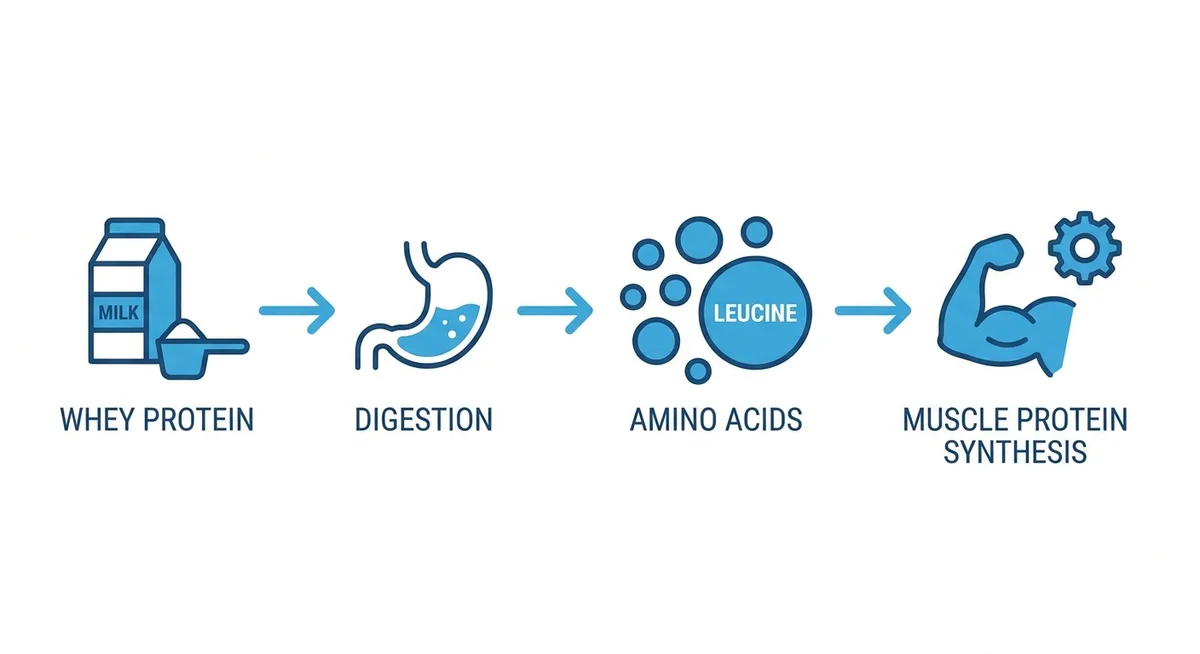
Resistance training creates microscopic damage in muscle fibres. That sounds bad, but it is the point. The damage triggers a process called muscle protein synthesis (MPS), where the body builds new protein strands to repair and reinforce the damaged tissue. If you supply enough amino acids at the right time, MPS runs at full capacity. If you don't, the body patches what it can with whatever is available, and growth is slower.
The trigger for MPS is not just total protein intake. It is specifically the arrival of amino acids, and in particular one amino acid called leucine, in the bloodstream at a concentration high enough to activate a signalling pathway called mTOR. Think of leucine as the key that starts the engine. Without enough of it in one dose, MPS stays in low gear no matter how much total protein you eat across the day.
Why does the type of protein change the outcome?
Not all proteins digest at the same speed. Casein (the other major milk protein) forms a slow gel in the stomach and releases amino acids over four to seven hours. That is fine for overnight recovery but not ideal right after training when you want a fast flood of amino acids. Whole food protein sources like chicken or eggs are digested more slowly still, because the body has to break down fat and connective tissue first before it can access the amino acids.
Whey proteins are "fast" proteins. They pass through the stomach relatively quickly and hit the small intestine as free amino acids and small peptides that absorb rapidly. Blood leucine peaks within 60 to 90 minutes of drinking whey, which lines up well with the post-training window when muscle tissue is primed to absorb nutrients.
Within the whey family, though, there is still a meaningful difference between concentrate and isolate:
| Protein type | Typical protein % | Fat content | Lactose content | Digestion speed |
|---|---|---|---|---|
| Whey concentrate (WPC 80) | ~80% | Moderate (4-8g per 100g) | Moderate (4-8g per 100g) | Fast |
| Whey isolate (WPI 90) | ~90% | Very low (<1g per 100g) | Very low (<1g per 100g) | Very fast |
| Hydrolysed whey | Varies (80-90%) | Very low | Very low | Fastest |
| Casein | ~80% | Low | Low | Slow (4-7 hours) |
Fat slows gastric emptying. So does lactose if your body processes it slowly. WPI 90 strips both of these out during the cross-flow microfiltration process, which means the amino acid cargo gets where it needs to go a little faster. In practice, the difference between WPI 90 and a quality concentrate is not enormous, but at the margins of recovery, margins matter.
How much leucine is actually in WPI 90?
A standard 30g scoop of WPI 90 delivers roughly 27g of protein (because the powder is about 90% protein by weight). Of that protein, around 11-12% is leucine, which works out to approximately 3 to 3.2g of leucine per scoop. Research consistently shows that 2.5g of leucine is the threshold needed to maximally stimulate MPS in healthy adults. One scoop of WPI 90 clears that bar comfortably.
Compare that to some plant-based proteins. Pea protein isolate, for example, contains around 8% leucine. You would need a larger serving to hit the same MPS trigger. That is not a reason to avoid plant protein, but it is why whey, and WPI 90 in particular, is efficient: you hit the leucine threshold with a single moderate scoop.
Does timing actually matter, or is it just gym mythology?
The old "anabolic window" claim, that you have exactly 30 minutes after training to down a shake or your gains disappear, was always overstated. The research is cleaner now: the window is wider, probably two to three hours post-training, and total daily protein intake matters more than any single timing rule.
That said, if you have not eaten for a few hours before training (which is common), getting protein in promptly after your session makes practical sense. You are not racing a 30-minute clock, but you are working with a body that has been running on its own amino acid stores and is ready to absorb more. A fast-digesting protein like WPI 90 is a logical fit here because it does not ask the digestive system to do extra work at a moment when blood is still redirected to working muscle.
For more on timing across different scenarios, the article on when to take whey protein covers morning, pre-training, and before-bed windows in detail.
What about recovery between sessions, not just after one?
If you train multiple times a week, recovery is not a single event. It is an ongoing process. Each session creates another round of muscle damage before the previous round is fully repaired. That is normal and expected, but it means your protein intake across the whole day matters just as much as the post-workout scoop.
What WPI 90 helps with
- Fast delivery of leucine to trigger MPS
- High BCAA content to support repair
- Low fat and lactose to avoid digestive drag
- Clean macro profile that fits any eating pattern
- Easy to fit into meals without cooking (shakes, yogurt, oats)
What WPI 90 won't do alone
- Replace adequate sleep (most repair happens overnight)
- Fix a consistently low total protein intake
- Offset inadequate calories during a hard training block
- Substitute for carbohydrates, which replenish muscle glycogen
- Work differently if you do not actually train consistently
The practical takeaway: use WPI 90 as one tool in a sensible daily eating pattern, not as a standalone recovery solution. Spread your protein across three or four meals. Make sure each meal hits roughly 25 to 40g of protein (depending on your size and goals). Let WPI 90 fill in the gaps where whole food is inconvenient, and use it post-training when you want a fast, no-fuss source that will not sit heavily in your stomach.
If you want to understand how your daily protein targets break down by goal, the goal-by-goal protein guide is a good read alongside this one.
Frequently asked questions
Is WPI 90 better than chicken or eggs for post-workout recovery?
Not categorically. Chicken and eggs are excellent protein sources with strong amino acid profiles. The practical advantage of WPI 90 post-workout is speed: it requires almost no digestion compared to whole food, so amino acids reach the bloodstream faster. If you can eat a full meal within an hour of training, whole food works fine. WPI 90 is more useful when you need something fast and light immediately after a session.
How does leucine in WPI 90 compare to other whey proteins?
All whey proteins are leucine-rich compared to most other protein sources. WPI 90 sits at around 11-12% leucine by protein weight, similar to whey concentrate. The advantage of WPI 90 is that because the protein content per scoop is higher (about 90% versus 80%), you reach the same leucine threshold with slightly less powder. The difference per serve is small but it adds up across a week of training.
Can WPI 90 help with muscle soreness (DOMS)?
Delayed onset muscle soreness is partly driven by inflammation from muscle damage. Adequate protein intake supports faster repair, which may reduce how long soreness lingers. There is also some evidence that the BCAAs in whey, particularly leucine and isoleucine, play a role in reducing exercise-induced muscle damage markers. WPI 90 is a good source of all three BCAAs. It will not eliminate soreness, but keeping protein intake consistent around training sessions is one of the more evidence-backed ways to manage it.
Should I take WPI 90 on rest days too?
Yes. Muscle repair does not stop because you are not in the gym. On rest days, the body continues rebuilding tissue from previous sessions, and it still needs amino acids to do that. Total daily protein intake matters more than whether you trained that day. A scoop on rest days, whether in a shake, stirred into yogurt, or mixed into oats, keeps your daily totals on track without much effort.
Try a premium WPI 90 that actually deliversHigh-leucine, fast-absorbing whey protein isolate. One ingredient, no fillers.