PDCAAS vs. DIAAS: How Protein Quality Is Actually Scored
When someone tells you their protein powder is "high quality," you're allowed to ask: according to what? There are two actual scoring systems that nutrition scientists use to rank protein sources, and understanding them takes about five minutes. Once you do, labels make a lot more sense and you stop paying for marketing words.
Key takeaways
- PDCAAS and DIAAS are the two main scientific methods for scoring protein quality.
- Both measure how well a protein supplies the essential amino acids your body can't make itself.
- DIAAS is the newer, more accurate method - and whey protein isolate scores near the top of it.
- A high score on either scale means more usable protein per gram you eat.
- Knowing these scores helps you compare powders, whole foods, and plant proteins honestly.
What is PDCAAS and how does it work?
PDCAAS stands for Protein Digestibility Corrected Amino Acid Score. The World Health Organization and the FDA adopted it in 1993 as the standard way to measure protein quality, and it was a big improvement over the older "biological value" method that just measured how much nitrogen a rat retained.
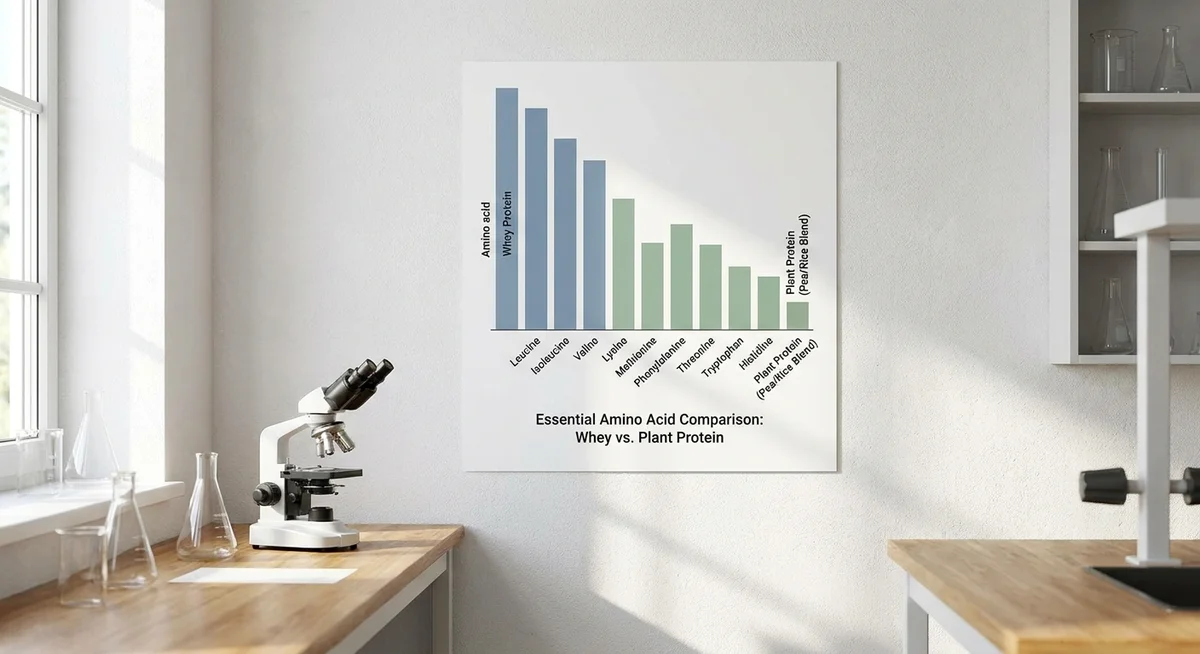
The formula is straightforward: take the amount of each essential amino acid in the protein, compare it against a reference pattern of human amino acid requirements, find the most limiting amino acid (the one that falls shortest), then multiply that ratio by the protein's digestibility score.
The result is a number from 0 to 1. A score of 1.0 means the protein meets or exceeds all essential amino acid requirements and is highly digestible. PDCAAS caps the score at 1.0, so even if a protein exceeds requirements, it gets rounded down.
Common PDCAAS scores:
| Protein Source | PDCAAS Score |
|---|---|
| Whey protein isolate | 1.00 |
| Casein | 1.00 |
| Egg white | 1.00 |
| Soy protein | 0.99 |
| Chickpeas | 0.71 |
| Wheat gluten | 0.25 |
| Peas | 0.67 |
The problem with PDCAAS? It truncates top scores at 1.0, so you can't see the difference between a protein that barely hits the threshold and one that clears it by a wide margin. And it measures digestibility in rats, not humans, which turns out to matter quite a bit.
What is DIAAS and why is it considered more accurate?
DIAAS stands for Digestible Indispensable Amino Acid Score. The FAO (Food and Agriculture Organization) recommended it in 2013 as a replacement for PDCAAS, and most nutrition researchers now consider it the better measurement.
Two things make DIAAS different:
- It scores amino acids individually. Instead of finding one limiting amino acid and using that as the score, DIAAS calculates a digestibility value for each essential amino acid separately. This gives a much more detailed picture of how a protein actually performs.
- It measures digestibility in the small intestine specifically. PDCAAS uses total-tract digestibility, which includes fermentation in the large intestine. That fermentation doesn't actually provide amino acids to your muscles. DIAAS measures true ileal digestibility, which is what actually gets absorbed and used.
DIAAS also allows scores above 1.0, so proteins that genuinely exceed requirements can be distinguished from each other.
DIAAS scores for common protein sources:
| Protein Source | DIAAS Score (adult reference) |
|---|---|
| Whey protein isolate | 1.09 |
| Whole milk | 1.14 |
| Egg | 1.13 |
| Casein | 1.08 |
| Soy protein isolate | 0.90 |
| Pea protein | 0.64 |
| Brown rice protein | 0.59 |
Notice that DIAAS separates things PDCAAS couldn't. Soy protein, which scores 0.99 on PDCAAS, drops to 0.90 on DIAAS. The gap between whey and pea protein is also much clearer. These aren't marginal differences. A DIAAS of 1.09 vs 0.64 means that gram for gram, WPI 90 delivers roughly 70% more usable protein than brown rice protein.
Does the score actually matter in practice?
Yes, and here's the clearest way to think about it. If you eat 30g of protein from a source with a DIAAS of 0.60, your body can actually use the equivalent of about 18g for muscle protein synthesis. The other 12g is either limiting due to an amino acid gap or doesn't absorb efficiently. If you eat 30g from a source with a DIAAS of 1.09, you're getting the full 30g working for you, plus some amino acid headroom.
This is why the amino acid profile of WPI 90 is worth understanding in detail. A high DIAAS score isn't just a number - it means every gram of protein on the label is doing what you bought it to do.
For people trying to build or maintain muscle, or anyone eating at a calorie deficit, this gap is genuinely significant. You'd need to eat considerably more of a lower-scoring protein to match what a single scoop of high-quality WPI 90 provides. That affects cost, volume, calories, and digestive load.
It's also why comparing WPI 90 to plant proteins on price alone doesn't give you the full picture. The per-gram protein cost looks different once you factor in how much of it your body can actually use.
PDCAAS strengths
- Simple, single number that's easy to compare
- Widely published, so historical data is abundant
- Still a reliable signal for identifying low-quality proteins
- Recognised by FDA and used in food labelling regulations
PDCAAS limitations
- Caps at 1.0, so top proteins look identical on paper
- Uses rat digestibility data rather than human data
- Measures total-tract digestibility, which overstates absorption
- Can't distinguish between proteins that genuinely exceed requirements
Should you be looking at these scores when buying protein?
Not every brand will publish a DIAAS score for their product, because measuring it is expensive and there's no regulatory requirement to do so. But you can use the scores for the ingredient itself. If a powder is made from whey protein isolate, you already know the base ingredient scores around 1.09 on DIAAS. The question then shifts to processing: how well has that score been preserved?
Heavy heat processing, harsh ion exchange methods, and excessive additives can degrade the protein's functional quality even if the amino acid profile stays nominally intact. This is why how a WPI 90 is made matters alongside what's in it. A product made using cross-flow microfiltration tends to preserve the native protein structure better than aggressive chemical processing, which keeps bioavailability closer to what the scoring tables show.
The practical checklist when evaluating a protein powder:
- Is the primary ingredient whey protein isolate (not a concentrate/isolate blend that's mostly concentrate)?
- Does the label show protein per 100g above 85-90g?
- Is the processing method stated (microfiltration is a good sign)?
- Are the additives minimal and identifiable?
If all four boxes tick, you're almost certainly buying something that performs close to the DIAAS score the ingredient earns in the literature.
Frequently asked questions
Is a DIAAS above 1.0 always better than exactly 1.0?
A score above 1.0 means the protein supplies more than the reference requirement for every essential amino acid. Practically speaking, anything at or above 1.0 is excellent for muscle building and general health. The difference between 1.09 and 1.13 is unlikely to be meaningful in a real diet. What matters more is using a high-scoring source consistently rather than chasing marginal differences between top-tier proteins.
Can I combine low-scoring proteins to get a higher effective score?
Yes. This is the logic behind combining rice and pea proteins, or eating rice and beans together. Each is limited by different amino acids, so together they fill in each other's gaps. The combined score of a well-designed plant protein blend can approach 0.85-0.90 on DIAAS. That's still meaningfully below WPI 90's 1.09, but much better than either ingredient alone. For vegans, thoughtful combining is a real strategy, not just a myth.
Does cooking or mixing whey protein affect its DIAAS score?
Mild heat (like mixing into warm oats) has minimal effect on amino acid content or digestibility. More aggressive cooking, like baking at high temperatures for extended periods, can cause some amino acid crosslinking (particularly lysine), which lowers digestibility slightly. The effect is generally modest for home cooking, but it's one reason drinking your WPI 90 in a shake is slightly more efficient than baking it into every meal.
Why don't labels show DIAAS scores?
Because there's no regulatory requirement to do so. PDCAAS is used in food labelling law; DIAAS is a scientific recommendation that hasn't been formally adopted in most countries' food regulations yet. As DIAAS becomes more established, you may start seeing it on premium products. For now, knowing the score for the ingredient type (whey isolate, pea, rice, etc.) gives you enough to make an informed call.
See how our WPI 90 is madeLearn about the sourcing and filtration behind our protein powder.