The Leucine Threshold: Why Your Protein Powder's Trigger Amino Acid Matters
Protein powders are not all doing the same job, even when the calories look identical on the label. The difference often comes down to one amino acid: leucine. It acts like a light switch for muscle protein synthesis, and if a single serve does not deliver enough of it, your body processes the protein but skips the muscle-building signal entirely. Knowing the leucine threshold, and picking a powder that clears it, changes how useful every shake actually is.
Key takeaways
- Leucine is the primary trigger for muscle protein synthesis, not just a building block.
- Research points to roughly 2.5 to 3 g of leucine per serve as the threshold where the anabolic signal fires reliably.
- WPI 90 typically delivers 10 to 12% of its protein content as leucine, meaning a standard 30 g serve clears the threshold with room to spare.
- Lower-grade proteins often need a bigger serve to hit the same leucine dose, costing you more per effective trigger.
- The full amino acid picture matters too, but leucine is where it starts.
What exactly does leucine do in the body?
Leucine is one of three branched-chain amino acids (BCAAs), alongside isoleucine and valine. All three are essential, meaning your body cannot make them and has to get them from food or supplements. But leucine has a job the other two don't: it directly activates mTORC1, the cellular pathway that tells muscle fibres to start building new protein.
Think of mTORC1 as the foreman on a construction site. Leucine is the call that gets the foreman out of the office. Once he's out, the other amino acids (your raw materials) can actually get used. Without enough leucine, the foreman stays put and the materials sit idle, even if you have plenty of them.
This is why the amount of leucine per serve matters independently of the total protein per serve. A powder with 25 g of protein but only 1.5 g of leucine is a weaker anabolic signal than one with 25 g of protein and 3 g of leucine, even though the headline number looks the same.
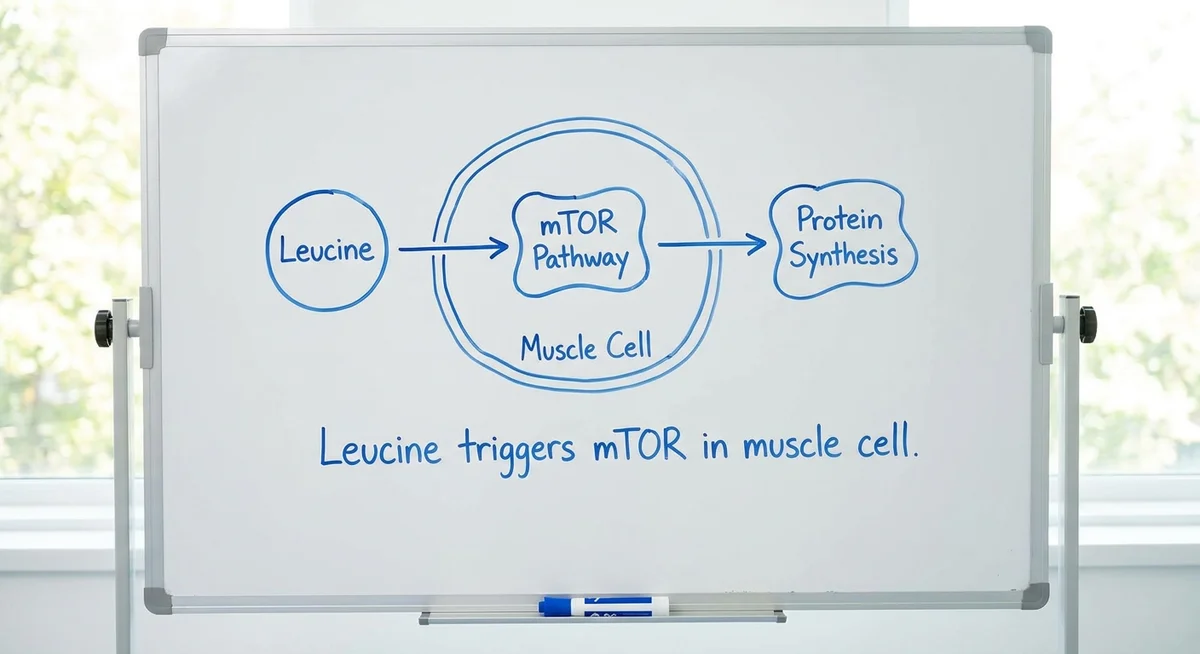
What is the leucine threshold and where does it come from?
The concept of a leucine threshold has been building in exercise science for about two decades. Early research by Norton and Layman in the mid-2000s established that muscle protein synthesis responded more like an on/off switch than a sliding scale when it came to leucine. Below a certain dose, little happened. At and above that dose, the signal fired.
More recent work has refined the number. The current consensus sits around 2.5 to 3 g of leucine per meal or serve as the point where MPS activates reliably in healthy adults. Some older adults or heavier athletes may sit closer to 3 to 3.5 g, which ties into why protein quality becomes more important after 40.
Hitting above the threshold does not keep adding to the signal linearly. Once you've cleared the switch, more leucine in the same serve does not mean more MPS in that window. This is why getting the right amount per serve matters more than simply adding more protein overall.
How does WPI 90 stack up against the threshold?
Whey protein, and WPI 90 in particular, is the benchmark for leucine content among common protein sources. Here is how different proteins typically compare on leucine percentage and the effective serve size needed to clear the 2.5 g threshold:
| Protein source | Leucine (% of protein) | Serve needed to hit 2.5 g leucine |
|---|---|---|
| WPI 90 | ~11–12% | ~22–25 g protein (1 standard scoop) |
| Whey concentrate (WPC 80) | ~10–11% | ~23–28 g protein (slightly more) |
| Casein | ~9–10% | ~25–30 g protein |
| Soy protein isolate | ~7–8% | ~32–36 g protein |
| Pea protein isolate | ~6–8% | ~32–42 g protein |
| Rice protein | ~5–7% | ~36–50 g protein |
A standard 30 g serve of WPI 90 at 90% protein content delivers around 27 g of protein, which puts leucine delivery at roughly 3 to 3.2 g per serve. That comfortably clears the threshold every time, with no need to double-scoop or stack with a separate BCAA supplement.
Plant proteins are not useless, but the numbers show why WPI 90 vs plant protein is not a straight swap at the same serve size. You would need to take considerably more pea or rice protein to fire the same anabolic signal, which changes the cost-per-effective-serve calculation completely.
Does timing affect how the leucine threshold works?
Yes, and this is where things get practical. Muscle protein synthesis has a refractory period. Once a leucine-triggered MPS response finishes, another dose of protein is needed to fire it again. Research suggests the window between spikes is roughly 3 to 4 hours. So four equally spaced meals or protein serves across the day is a more effective pattern than one or two large ones, even if total protein intake is the same.
This matters for how you structure your day. A 60 g protein shake might seem efficient, but the leucine in the second 30 g is less useful if your body is still in the refractory period from the first. Two separate 30 g serves three to four hours apart will generally produce two MPS events where one big serve only produces one.
Post-training is still the most studied and most reliable window. After resistance training, muscle tissue is primed to respond to leucine more readily, and that window lasts several hours. A WPI 90 serve here is a well-timed dose that hits a receptive target. You can read more about the timing side in when to take whey protein and how timing affects absorption.
What about leucine supplements on their own?
Standalone leucine powder and BCAA supplements are popular, and they do raise blood leucine levels quickly. The problem is context. Leucine triggers the MPS signal, but you still need sufficient total amino acids, particularly the essential ones, to actually build new muscle tissue. Leucine without adequate protein in the same window is like calling the foreman to a site with no building materials.
The practical upshot: a quality complete protein source that already clears the leucine threshold, like WPI 90, makes BCAA supplementation redundant for most people. You are paying for the trigger and the materials in one serve.
Why WPI 90 works well for leucine
- High leucine percentage (~11–12%) means standard serves clear the threshold reliably
- Fast absorption puts leucine into the bloodstream within 30–60 minutes
- Complete amino acid profile provides the building blocks alongside the trigger
- Low fat and carbohydrate content means you get a clean leucine signal without extra calories
Where other proteins fall short
- Plant proteins need significantly larger serves to match leucine delivery
- Collagen protein contains almost no leucine, making it useless for MPS triggers
- Some blended proteins dilute leucine content with lower-quality fillers
- Casein's slower absorption delays the leucine spike, which matters in time-sensitive windows
Frequently asked questions about leucine and protein
How do I know if my current protein powder clears the leucine threshold?
Look for the amino acid profile on the product page or tub. Find the leucine value per serve. You want at least 2.5 g, ideally 2.7 to 3.2 g, for a standard single serve. If the brand does not publish an amino acid breakdown, treat that as a yellow flag and check whether an independent lab has tested the product.
Can I get enough leucine from whole food protein alone?
Yes, absolutely. Chicken breast, eggs, beef, fish, and dairy all carry meaningful leucine. A 150 g chicken breast delivers roughly 3.5 g of leucine. The advantage of WPI 90 is speed of absorption and convenience, not that it is the only source. For anyone struggling to hit protein targets through food, it closes the gap without adding much else to the meal.
Does leucine content change after WPI 90 is manufactured or stored?
Amino acids are stable molecules. Heat, light, and moisture affect protein powder quality more broadly, but they don't selectively destroy leucine. Keep the tub sealed, away from direct sunlight, and use within the best-before date, and the amino acid profile you bought is the one you're getting throughout the tub's life.
Is there such a thing as too much leucine per serve?
Beyond the threshold, additional leucine in the same serve does not produce a stronger MPS signal in that window. There's no known harm from higher leucine intakes, but there's also no extra benefit in the context of a single meal. Spreading protein across the day gets you more MPS events than stacking leucine into one large serve.
See our WPI 90 and what's inside every scoopFull amino acid profile, sourcing details, and everything on the label explained.