How to Spread Your Protein Throughout the Day (And Why It Beats One Big Dose)

Most people track their daily protein target like it's a single bank account: hit the number and you're done. But your muscles don't care about your daily total. They care about what shows up at each meal. Spreading protein across 3 to 5 eating windows, rather than loading it into one or two big meals, gives your body more opportunities to trigger muscle protein synthesis throughout the day. WPI 90 makes that easy because it's fast to prepare and high in protein per serve.
Key takeaways
- Muscle protein synthesis gets triggered in short bursts, not continuously - you need regular protein doses, not one giant one.
- Each meal should ideally deliver 25 to 40 g of protein to hit the leucine threshold and kick off synthesis properly.
- WPI 90 works as a fast, low-calorie way to top up meals that would otherwise fall short.
- Breakfast and the post-workout window are the two most commonly underfed protein opportunities.
- Spreading intake evenly over the day is more effective than skewing it all to dinner.
Why does protein timing actually matter?
Muscle protein synthesis (MPS) is the process your body uses to build and repair muscle tissue. It's not running constantly in the background. It spikes after you eat a protein-rich meal, peaks around 90 minutes to 2 hours later, and then returns to baseline, regardless of whether you eat more protein shortly after. This means if you eat 20 g at breakfast, 15 g at lunch, and then 90 g at dinner, you've only triggered MPS twice in a meaningful way. The leftover protein at dinner doesn't go back and fix the gap from earlier in the day.
Research consistently shows that spreading protein across 4 or more meals produces better muscle-building outcomes than skewing the same total intake toward 1 or 2 sittings. This holds even when total daily intake is identical across both groups.
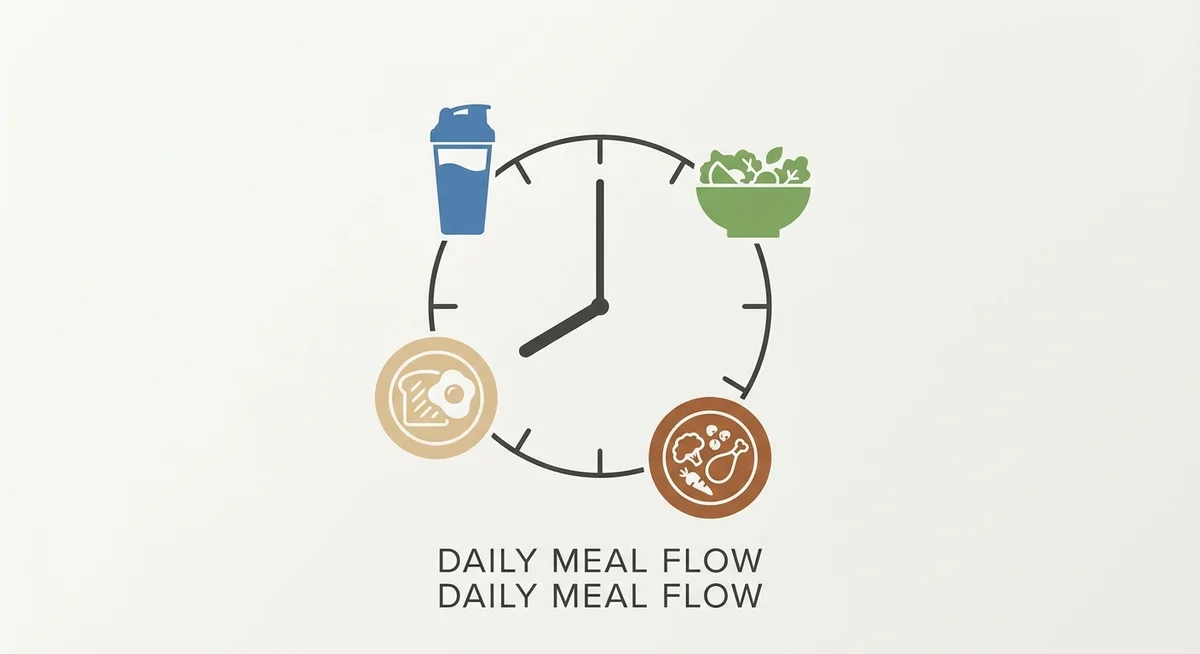
How much protein does each meal actually need?
There's a threshold your body needs to clear before MPS really switches on. It comes down to leucine, the branched-chain amino acid that acts as the trigger. Most research puts the effective dose between 2.5 g and 3 g of leucine per meal, which typically translates to about 25 to 40 g of a high-quality complete protein source.
WPI 90 delivers roughly 26 to 27 g of protein per standard serve and is rich in leucine (around 2.7 g per serve), which puts it right inside that trigger zone. That's one reason why it's a practical top-up for meals that don't hit the threshold on their own - like a light breakfast or a salad lunch that's long on vegetables but short on protein.
If you want to understand the leucine angle in more depth, the article on the leucine threshold and why it matters per scoop covers the science clearly.
What does a well-spread protein day actually look like?
Here's a practical example for someone targeting 160 g of protein per day. The exact foods shift based on your diet, but the structure is what matters.
| Meal | Example foods | Protein (approx.) |
|---|---|---|
| Breakfast (7am) | 3 eggs, Greek yoghurt, WPI 90 shake | ~50 g |
| Lunch (12pm) | Chicken breast, rice, salad | ~40 g |
| Afternoon (3pm) | WPI 90 shake, handful of almonds | ~28 g |
| Dinner (6:30pm) | Salmon fillet, vegetables, legumes | ~42 g |
Four distinct windows. Four MPS triggers. The afternoon shake is doing the job a lot of people skip entirely - filling the gap between lunch and dinner when the day gets busy and food choices get worse.
Where does WPI 90 fit best in a full day?
WPI 90 isn't only a post-workout drink. Because it mixes in 30 seconds and sits at roughly 110 calories per serve (with nearly all of those coming from protein), it's a genuinely flexible tool across the whole day.
Best windows for WPI 90
- Breakfast: Most people under-eat protein in the morning. A shake alongside eggs or oats fixes this fast.
- Post-workout: Classic for good reason. Fast absorption when your muscles need it most.
- Mid-afternoon: Bridges the gap between lunch and dinner without adding much fat or carbs.
- Before bed: Can support overnight recovery, particularly for people training twice a day.
When a shake probably isn't the priority
- If your meal already hits 35+ g: A shake on top won't trigger more MPS, it just adds calories.
- When you're already in a surplus: Protein timing matters less if you're consistently overshooting calories.
- As a replacement for every meal: Whole foods bring micronutrients, fibre, and satiety that a shake doesn't match.
Does the gap between meals matter?
Yes, but not in a stressful way. You don't need to set alarms every 3 hours. The practical target is to avoid stretches longer than about 5 to 6 hours where you've eaten no meaningful protein. A 14-hour overnight fast is fine. A 10-hour stretch between lunch and a late dinner, where you had a handful of crackers in between, isn't ideal if you're actively trying to build muscle.
The goal is just consistency over perfection. Four well-timed protein windows beats two perfect ones plus two terrible ones.
If you want to pair your timing with a clear daily target, the breakdown in how much protein you actually need, broken down by goal, gives you a solid starting number to work from.
What about total daily intake? Does that still matter?
Absolutely. Timing is a layer on top of total intake, not a replacement for it. If you're hitting 80 g a day spread perfectly across 4 meals, you're still under-eating for any serious muscle-building goal. Get the total right first - typically 1.6 to 2.2 g per kg of bodyweight for active people - then think about how to distribute it. The quality of the protein you choose also factors in. A high-purity WPI 90 is doing more work per gram than a lower-grade concentrate or a heavily processed blend.
Frequently asked questions
Can you eat too much protein in one sitting?
Your body can digest and absorb more protein than the MPS threshold - it won't "waste" it. But above roughly 40 g at a sitting, you're unlikely to get additional muscle-building benefit from that meal. The extra protein will be oxidised for energy or stored. It's not harmful, it's just not doing the muscle work you might expect it to.
Does protein timing matter if you're not training hard?
Less so. For people who are sedentary or doing light activity, total daily protein intake is the main variable. Timing becomes more relevant when you're training 4 or more times per week and recovery between sessions actually matters to your performance and adaptation.
Is WPI 90 better than whole food for topping up protein between meals?
For convenience, yes. A shake takes 30 seconds and delivers a clean, measured dose. Whole foods often win on satiety and micronutrients though. The honest answer is that both have a place - shakes fill the gaps that whole food can't practically cover, especially during busy stretches of the day.
How long after a workout should I have my protein?
The "anabolic window" is real but wider than most gym lore suggests. Eating within 2 hours post-workout is plenty. If you trained fasted first thing in the morning, sooner is better. If you had a meal an hour before training, the post-workout rush matters less. Protein timing and absorption windows covers this in more detail if you want to dig in.
See our WPI 90 rangeHigh-purity protein designed to work across your whole day, not just the post-workout window.