How Fast Does Whey Protein Actually Work After You Drink It?

You shake, you drink, you move on. But inside your gut something genuinely interesting is happening. Whey protein is digested and absorbed faster than almost any whole food you could eat, and that speed has real, measurable consequences for muscle building and recovery. Here is exactly what the clock looks like from the first sip to the last amino acid entering your muscle cell.
Key takeaways
- Whey protein hits peak blood amino acid levels in around 60 to 90 minutes after drinking it.
- Muscle protein synthesis (MPS) can be elevated within 1 to 2 hours and stays raised for up to 3 hours.
- WPI 90 absorbs slightly faster than concentrate because there is almost no fat or lactose to slow digestion.
- The total protein dose matters more than perfect timing, but timing does give you a real edge post-workout.
- Spreading shakes across the day keeps MPS elevated longer than one large dose ever could.
What actually happens when whey hits your stomach?
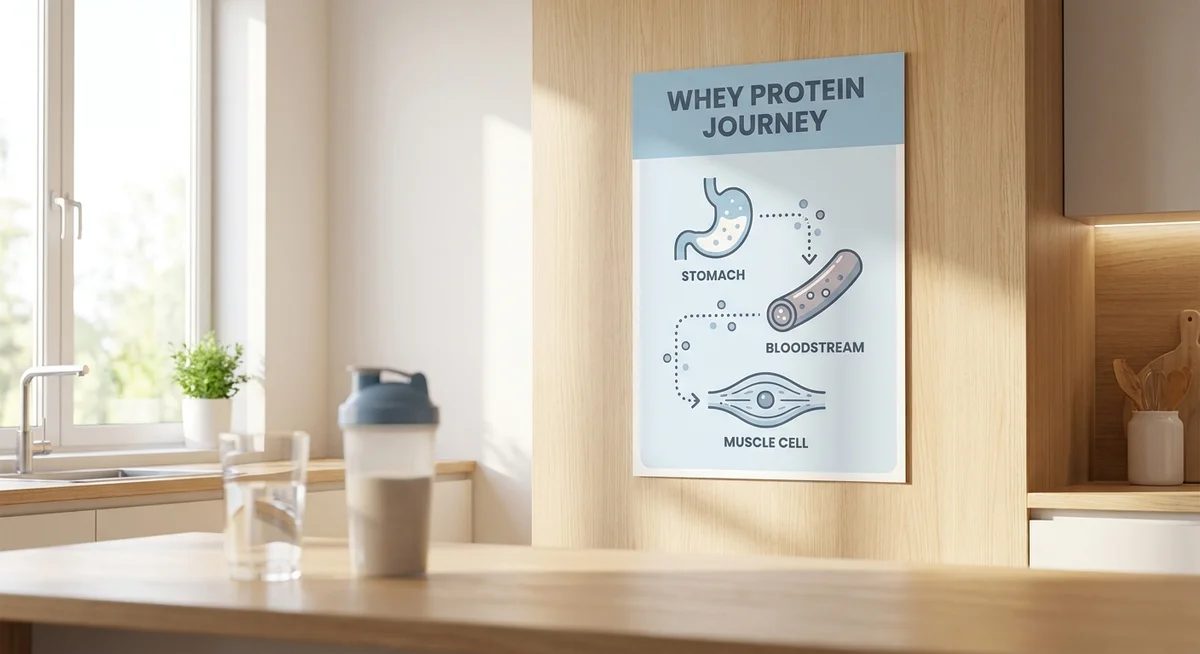
Whey protein is a "fast" protein because it stays liquid in the stomach. Solid foods, and even casein, form a gel or curd that takes hours to break down. Whey skips that step. Your stomach acid and digestive enzymes (mainly pepsin and then pancreatic proteases in the small intestine) chop the protein chains into smaller peptides and free amino acids fairly quickly, usually within 20 to 40 minutes of drinking. Those fragments then get transported across the wall of the small intestine directly into the bloodstream.
From there, amino acids travel to the liver first. The liver takes a cut, using some for its own repair work and to synthesise plasma proteins. What gets past the liver enters the general circulation and is available to muscle tissue, which is the part we actually care about.
How long until amino acids actually reach your muscles?
Research using isotope-labelled amino acids (basically, scientists tag individual amino acids so they can track them) shows that whey protein reaches peak plasma amino acid concentration somewhere between 60 and 90 minutes after consumption. For leucine specifically, the amino acid that most directly triggers MPS, that peak can come as early as 45 minutes in some studies.
Muscle protein synthesis itself is measurably elevated within about 1 to 2 hours of drinking whey, and it stays elevated for roughly 2 to 3 hours before returning to baseline. That gives you a real, productive window, but it also tells you why hammering two scoops at once is not always smarter than having one now and one later.
| Protein Type | Time to Peak Plasma Amino Acids | MPS Window | Best Use Case |
|---|---|---|---|
| WPI 90 | 45 to 75 minutes | 2 to 3 hours | Post-workout, between meals |
| Whey Concentrate | 60 to 90 minutes | 2 to 3 hours | Post-workout, general use |
| Casein | 3 to 4 hours | 4 to 5 hours (lower peak, longer tail) | Pre-sleep, long gaps between meals |
| Whole food (chicken) | 2 to 4 hours | 3 to 4 hours | Main meals |
| Hydrolysed Whey | 30 to 60 minutes | 2 to 3 hours | Post-workout (marginal advantage) |
Does WPI 90 absorb faster than regular whey concentrate?
Yes, meaningfully so. The difference comes down to what is not in the powder. Whey protein concentrate contains fat and lactose alongside the protein. Both slow gastric emptying, meaning the stomach holds onto its contents longer before releasing them into the small intestine. WPI 90, after cross-flow microfiltration, is typically 90% or more pure protein with almost no fat and very little lactose. Less stuff to process means faster transit and an earlier amino acid spike.
The practical difference is probably 15 to 30 minutes in peak timing. That is not going to make or break a session, but if you are eating a full meal right before training and need a protein top-up immediately after, WPI 90 is the option that gets to work sooner. For a full breakdown of what sets the two apart, the article on WPI 90 vs. whey protein concentrate covers the numbers in detail.
Does it matter when you drink it?
The "anabolic window" idea, the notion that you have exactly 30 minutes post-workout or the session was wasted, is mostly overstated. Total daily protein intake is the bigger driver of muscle gain. That said, there are real arguments for taking whey close to training:
- Post-workout MPS is elevated already. Your muscles are primed and more receptive to amino acid uptake for a few hours after resistance training. Hitting that window with fast-absorbing protein does amplify the response.
- Blood flow to muscle is higher right after exercise. More blood flow means amino acids arrive faster and in greater concentration.
- Fasted morning training is a different story. If you trained without eating, you are in a catabolic state. Here timing matters more and whey right after (or even before) makes a bigger difference than it would for someone who trained after lunch.
The broader picture on daily timing is covered in depth in the guide on spreading your protein across the day. The short version: four protein servings across the day produces more total MPS than two larger ones, even if the two big ones add up to the same grams.
What slows absorption down, and is that ever useful?
A few things will extend the time it takes for whey amino acids to peak:
- Mixing with milk instead of water. Milk adds fat and extra protein (casein), both of which slow gastric emptying. Blood amino acids rise more gradually, which may actually help satiety but won't give you as sharp a post-workout spike.
- Drinking it with a large meal. Stomach contents mix, and everything empties more slowly.
- High-fibre additions. Blending with oats or fruit slows the whole process down.
Is slower absorption ever useful? Sometimes yes. If you are taking whey before a long run or want it to carry you through a few hours without another meal, mixing it with milk or including some carbs and fat is a reasonable call. For a straight post-workout hit, water is better.
For a faster hit (post-workout)
- Mix WPI 90 with cold water
- Drink within 30 to 60 minutes of finishing training
- Keep the serving to a standard dose (25 to 35g protein)
- Avoid heavy fat or fibre in the same sitting
For a slower release (pre-sleep or long gap)
- Mix with milk for extra fat and casein
- Add oats or nut butter to the shake
- Or switch to casein protein entirely for overnight use
- A slightly larger dose makes sense here (30 to 40g)
FAQ
How long does it take for a whey protein shake to start working?
Digestion begins immediately, but amino acids typically reach measurable levels in your bloodstream within 30 to 45 minutes. Peak plasma amino acid levels arrive around 60 to 90 minutes after drinking. Muscle protein synthesis responds within 1 to 2 hours and stays elevated for about 2 to 3 hours after that.
Is WPI 90 absorbed faster than other protein powders?
Faster than concentrate, casein, and most plant proteins, yes. The low fat and lactose content in WPI 90 means your stomach empties it into the small intestine quickly. Hydrolysed whey is technically faster, but the practical difference post-workout is small enough that most people won't notice a training benefit from choosing it over a quality WPI 90.
Does taking whey immediately after a workout actually make a difference?
It helps, but the effect is smaller than supplement marketing would have you believe. If you ate a protein-rich meal 1 to 2 hours before training, your muscle protein synthesis is already supported. Post-workout whey makes the biggest difference when you trained fasted or it has been 4 or more hours since your last meal. Either way, total daily protein intake is the primary driver of results.
Can your body only absorb a certain amount of protein at once?
Your gut can absorb more protein than you can reasonably eat in one sitting. The real constraint is how much your muscles can actually use for building. Research suggests somewhere around 20 to 40 grams per meal is the productive range for MPS, depending on your size and training level. Beyond that, the extra amino acids get oxidised for energy rather than going to muscle. This is exactly why spreading protein across 3 to 4 meals outperforms front-loading it all at once.
See what a quality WPI 90 actually looks likePremium whey protein isolate with a full amino acid profile and 90%+ protein content per serve.