Spray Drying: The Step That Turns Liquid Whey Into Powder
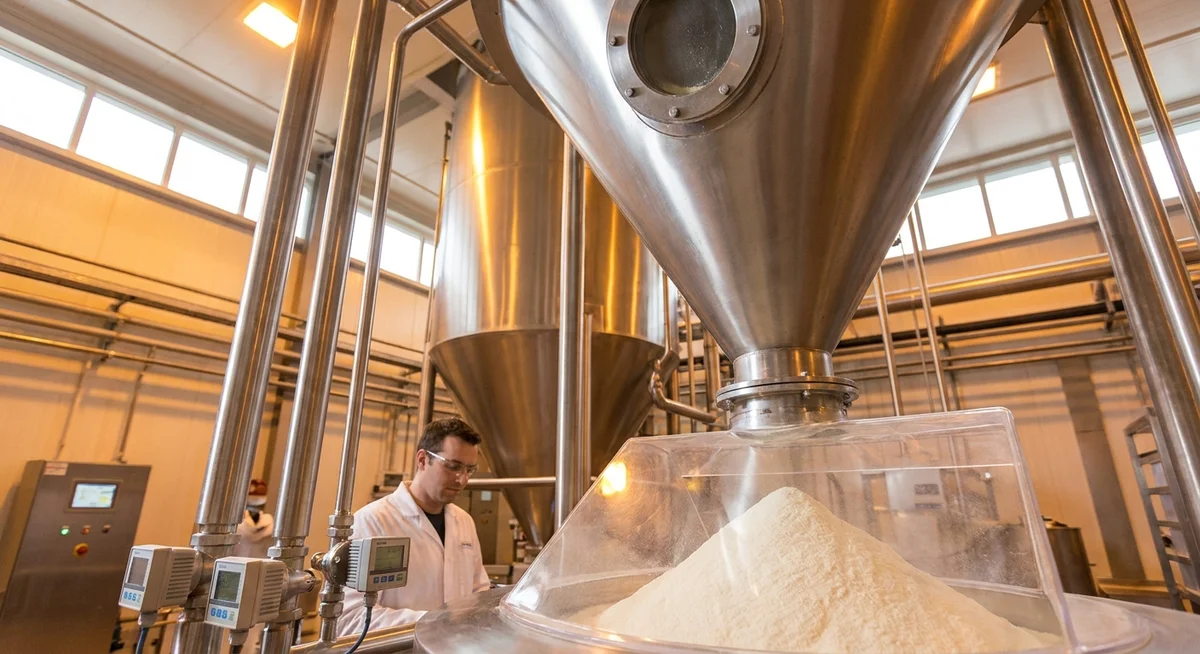
After filtration strips out the fat and lactose, liquid whey still isn't powder. It's a concentrated liquid with around 20-30% solids. Getting it to the dry, scoopable form you buy requires one more step: spray drying. That step sounds simple but it's where a lot of protein quality is either preserved or quietly lost.
Key takeaways
- Spray drying converts liquid whey concentrate or isolate into dry powder by atomising it into a hot air chamber.
- Inlet air temperature is the main quality lever - too hot and proteins denature; too low and the powder stays wet and clumps.
- Better manufacturers run lower temperatures and shorter dwell times to protect native protein fractions like lactoferrin and beta-lactoglobulin.
- Powder particle size, bulk density, and how well it mixes in water are all direct outputs of how the drying is controlled.
- Agglomeration (a second pass through steam or moist air) is what gives instant-mix powders their clump-free behavior.
What actually happens inside a spray dryer?
A spray dryer is essentially a very tall metal tower. Liquid whey is pumped to the top and fired through an atomiser - either a spinning disc or a high-pressure nozzle - which breaks it into a fine mist of tiny droplets. Hot air (typically between 160°C and 220°C at the inlet) flows through the chamber at the same time. Each droplet is so small that the surface area is enormous relative to its mass, so moisture evaporates almost instantly - we're talking milliseconds to a few seconds of total exposure before the now-dry particle falls to the collection cone at the bottom.
The dried particles are then swept out by the airflow into a cyclone separator, which spins them out of the air stream and deposits them into collection bags or a conveyor. That's the powder you eventually open.

Why does temperature control matter so much?
The inlet temperature is the key variable. Here's the tension: you need enough heat to evaporate the water quickly, but protein starts to denature (its structure unfolds and loses function) at temperatures above roughly 70-80°C. The clever part of spray drying is that the droplet stays cool as long as there's moisture to evaporate, because evaporation absorbs heat. The particle's surface temperature tracks the wet-bulb temperature of the air, not the dry-bulb inlet temperature, so it stays manageable.
But once the moisture is gone, the temperature climbs fast. That's why outlet temperature matters just as much as inlet. Manufacturers who want to protect the protein's native fractions run lower inlet temperatures and pull the particles out before the outlet temperature spikes. It costs more (you need a bigger dryer or slower throughput) but it's the difference between a powder with its native protein fractions largely intact and one that mixes fine but carries some thermal damage.
How spray drying affects the powder you actually use
| Property | Lower-temp, careful drying | Higher-temp, faster drying |
|---|---|---|
| Protein integrity | Native fractions largely intact | Some denaturation, fewer native fractions |
| Solubility | Good to excellent | Can be poor, fine-but-lumpy mix |
| Flavour | Clean, mild dairy notes | Slightly cooked, sulphurous off-notes |
| Particle size | Fine and consistent | More variable, can be dusty |
| Colour | White to off-white | Cream to light yellow |
What is agglomeration, and why do some powders mix better than others?
Basic spray-dried powder is very fine - almost like talc. That's actually bad for mixability because the particles pack tightly together, trap air, and float on the surface of your liquid. This is why cheaper powders often clump when you add water.
The fix is agglomeration. After the initial drying, the fine powder is re-exposed to a small amount of steam or moist air, which makes the particle surfaces sticky. They clump together into larger, porous clusters. These larger clusters sink into liquid quickly, let water penetrate through their pores, and dissolve much faster. It's the same reason instant coffee dissolves so easily compared to regular ground coffee.
When a protein powder claims to be "instantised," that's what they mean: it's been agglomerated. Done well, it's a genuine improvement. Done cheaply - or with the wrong lecithin additions - it can affect taste and leave a slightly grainy texture. Sunflower lecithin is generally cleaner than soy lecithin for this purpose, which is worth knowing if you're checking what to look for when comparing protein powders.
What this means for WPI 90 specifically
Whey protein isolate at 90%+ purity is already a delicate product coming out of filtration. The protein fractions that make WPI 90 worth buying - beta-lactoglobulin, lactoferrin and other minor whey proteins - are more heat-sensitive than the proteins in a basic concentrate. This is why the spray-drying conditions matter more for WPI 90 than for WPC 80.
A concentrate has more fat and lactose acting as a buffer. An isolate is stripped back, which means the proteins are more directly exposed to the drying conditions. Manufacturers who understand this dial down the temperatures and accept the slower production speeds. Those who don't produce a powder that still hits the protein percentage on the label (because denatured protein still registers as protein by standard testing methods like Kjeldahl) but has fewer of its native protein fractions intact.
This is one of the reasons quality sourcing decisions matter at the production level, not just at the ingredient level. Two WPI 90 powders can have identical labels and very different manufacturing histories.
Signs of careful spray drying
- White or very pale off-white colour
- Clean, mild smell with no eggy notes
- Mixes easily with a brief shake or stir
- Smooth texture, no gritty residue
- Manufacturer mentions outlet temperature controls
Signs of aggressive drying
- Cream or yellow tinge to the powder
- Slightly cooked or sulphurous smell
- Clumps when water is added
- Gritty finish or chalky aftertaste
- No mention of processing controls anywhere
FAQ
Does spray drying denature all the protein?
Not all of it, no. The evaporative cooling effect protects proteins during most of the drying cycle. How much denaturation occurs depends on inlet temperature, droplet size, dwell time inside the chamber, and outlet temperature control. Well-run operations preserve the majority of native protein fractions. The question is always degree, not a binary yes/no.
Is freeze-dried whey protein better than spray-dried?
Freeze-drying (lyophilisation) uses very low temperatures and a vacuum to sublimate moisture, which is far gentler on proteins. But it's also 10 to 20 times more expensive and produces a powder with different handling properties. It's practical for pharmaceutical-grade ingredients but not realistic for a protein supplement at normal pricing. Good spray drying at controlled temperatures is the viable alternative, and it produces an excellent product when done right.
Can you tell how a powder was dried just by looking at it?
You can get a good indication. Colour, smell, and how the powder behaves in water are all downstream effects of the drying conditions. A clean-smelling, white, fast-dissolving powder suggests controlled drying. A yellowish, slow-to-dissolve powder with any off-notes is a reasonable flag that the process ran hot. It's not a perfect test, but it's a useful starting point when you're comparing options on the shelf.
Does agglomeration reduce protein quality?
When done properly, no. Agglomeration uses steam or fine water droplets at relatively low temperatures for a very short exposure. It changes the physical structure of the powder (particle clustering) without meaningfully altering the protein content or its fractions. The bigger variable is what additives are used as part of the process - lecithin type and quantity can affect taste and texture more than the agglomeration step itself.
Browse our WPI 90 range Carefully sourced, controlled-temperature spray dried whey protein isolate at 90%+ purity.